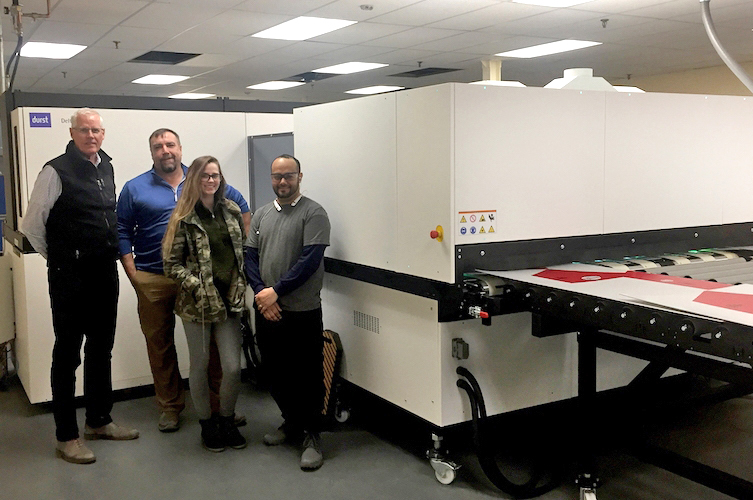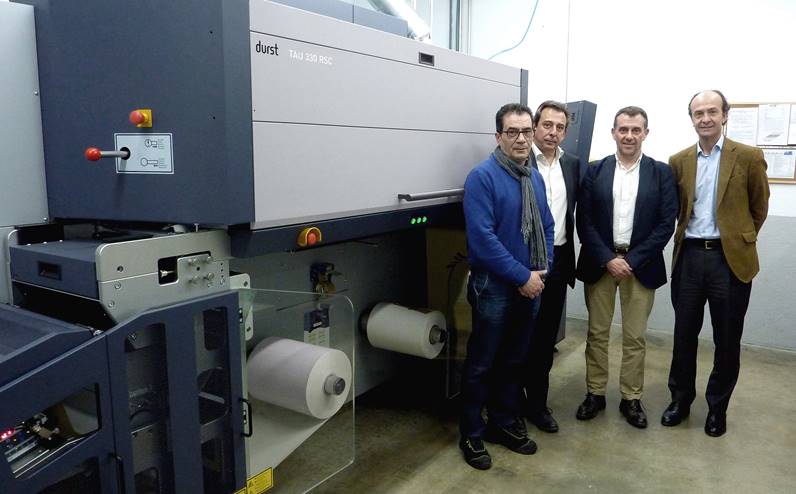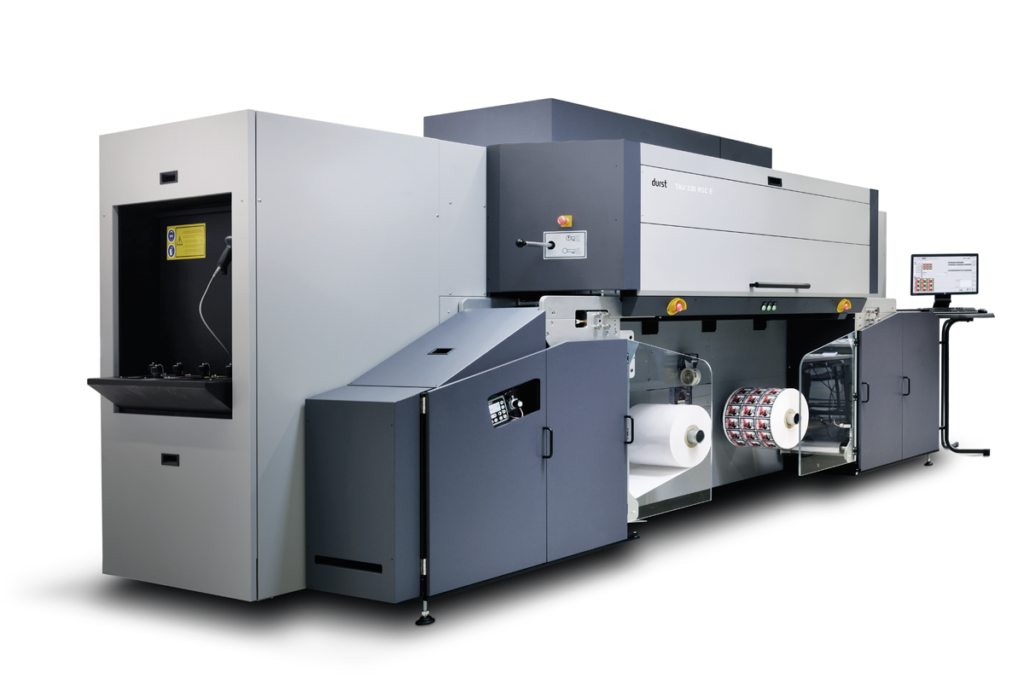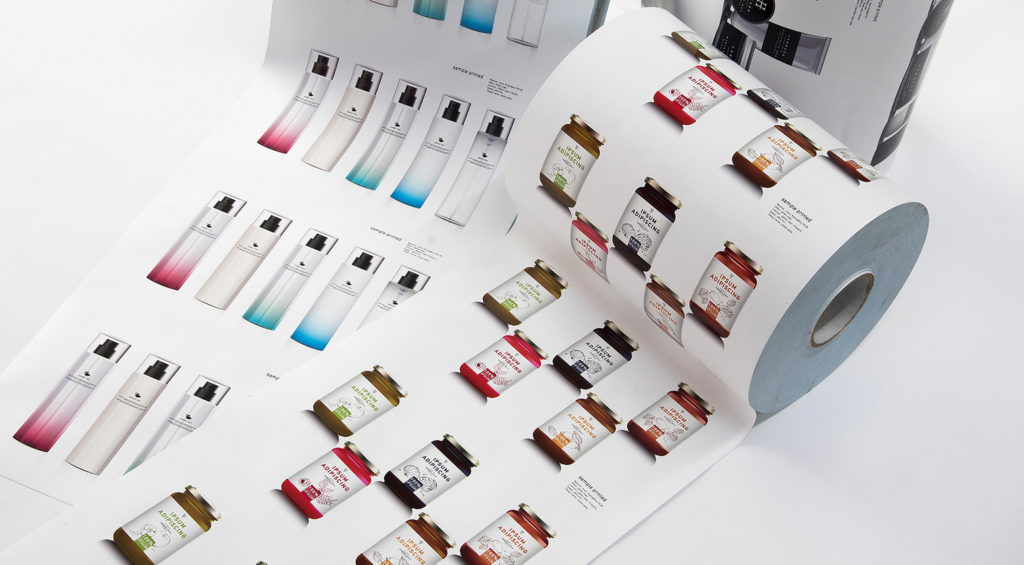

Me & my: Durst Rhotex 325

Last July, Cardiff based large-format print specialist 3 Sixty expanded its textile printing with major investment in a 3.2m dye-sublimation printer and associated ancillaries.

Together with the skilled seamstresses who sew and finish the products, the new kit is now responsible for 25% of the company’s business, according to managing director Richard Inkin.

He and business partner Ben Newton set up 3 Sixty in 2010, having entered the printing sector 10 years earlier following an early career with the merchant bank Coutts. “One of my clients was a printer and basically asked me whether I fancied a change? It was 2000 and it was just the right time with the way the banking industry was going.”

The basis of the company is its three-word marketing message and offering: ‘Audit, Print, Installation’. Audit means getting to know the customer’s needs and suggesting the solution, including offering agency design services. “We are very good listeners; it’s a key part of our service,” says Inkin. “We listen first and then impart our plan to deliver excellence to our clients.”

Printing is through a range of wide format inkjets, primarily a pair of EFI Vutek UV machines, a QS2000 and a GS3200 which were joined by a new Durst P10 250 HS Plus UV hybrid at the same time as the Rhotex 325, plus a 1.6m HP Latex printer, which can also be used for textiles as well as wall coverings. In the past three weeks it has installed a PrintFactory modular automated workflow to handle colour management and job scheduling.

Installation is the third arm of the service, with 3 Sixty able to take on anything from a single site up to full retail chains of hundreds of stores in a seven- to 10-day period. Installers go in with handheld devices linked to 3 Sixty’s cloud system so they can photograph and document the process for customers to see.

The main business areas it works with are POS; exhibitions, events and brand activation; window displays; interior design (fire retardant textiles, wallpapers, flooring, window films); and signage.

Inkin says the main textile applications are “both supplied on the roll or converted by our skilled seamstresses into soft furnishings, such as curtains, cushions, bolsters, covers, tablecloths and roller blinds.”

Other textile work is what’s loosely classed as soft signage or plastic coated banners – flags of various styles and shapes, drapes, tension frame systems, exhibition graphics, fence and crowd control scrim and barrier jackets. Welders and eyeletters are used to finish the banners.

A pair of Zünd digital cutting tables are used to cut simple or complex shapes. 3 Sixty employs three or four seamstresses depending on the workload and has a variety of industrial sewing machines for them to do the assembly work on. “For more capacity we recently installed a second Zünd G3 3.2m machine to cope with the additional demand created by our fabulous new investments,” says Inkin.

“We make simple and complex products, from bolster cushions and curtains to bespoke bar covers. The speed of the Zünds gives our skilled finishing team the time to really add value and create all manner of products. We’ve got seven or eight different sewing machines that are used depending on the type of finish that’s required.”

The Durst P10 250 HS Plus installed at the same time as the Rhotex was intended to expand capacity for existing work, says Inkin. “Being a hybrid machine it allows us to print both rigid and roll media at high speed with exceptional quality. We can run high-quality banner work, wall wraps, direct-to-substrate to a variety of media, from the everyday Foamex and Correx boards, to more bespoke requirements such as adhesives, acrylics and more sensitive plastics and now environmentally friendly options to plastics. The P10 sits alongside our UV Vuteks and HP Latex machines. We use our P10 for commercial wallpapers and we do also use the Latex for smaller more decorative projects.”

Why choose the Rhotex 325?

This was 3 Sixty’s first dye-sublimation printer, Inkin says. “We printed fabrics by UV before, but this process is not as good. We also run some display work on HP Latex.” He says the attraction of the dye-sublimation inks is they preserve the natural ‘hand’ feel of textiles, unlike UV and Latex inks that stay on the surface and alter how it feels and flexes.

“The dyes are infused into the substrate rather than applied to the top level and therefore it doesn’t crack, it doesn’t fade, it doesn’t peel away from the substrate,” he says. In addition UV inks can’t be used with fabrics that contact skin, such as garments and soft furnishings,” he says.

“The reason we bought the Rhotex is not only because it’s the best in its class for quality, reliability and speed, but also because of Durst’s water-based disperse dyes. They are labelled Oeko-Tex Standard 100, meaning they work perfectly across a wide range of media. We can print onto wide width fabrics up to 3.2 metres wide, but a lot of textiles are still only woven at 1.5m (60in) so we can be very flexible with our approach to what we can offer.”

The Durst Rhotex 350 is a 3.5m-wide inkjet printer that uses water based dye-sub inks and can run at a maximum of 390m²/hr, though the higher quality ‘production’ and ‘backlit’ modes are 170m² and 130m²/hr. It uses Durst’s own WTS variable drop size piezo print head technology that’s tailored to water-based inks and incorporates an automated nozzle cleaning system. It can feed both transfer papers and textiles roll-to-roll. There’s an integrated hot air dryer, though final heat sublimation has to be done as a post-process.

Media expertise

3 Sixty uses its Rhotex for both direct printing to the textile and for printing on to paper for later transfer to the textile as a separate post-process. “We use both and have built our knowledge base with support from Durst, our media suppliers and having the internal expertise to test and evaluate the best products to fit our customer’s needs,” says Inkin.

“We find that most of the display fabrics we run can be printed direct to substrate. However, we always use paper transfer for any substrates that have any elastane content or our furnishing range, to ensure the highest quality finish.” Elastane is used for stretchable fabrics such as Lycra/Spandex.

The dye-sublimation process requires textiles to have a high proportion of polyester fibres, which absorb and bond with the vaporised ink pigments in the heat fixing process. “We have a very varied range of substrates that we print on our Rhotex, these are all 100% polyester bases but some have up to 5% elastane content,” says Inkin.

“We haven’t yet tried any mixed textiles, ie poly-cotton mixes, simply because so far our clients have not requested this. The concern would be the wash fastness of the dyes on the mixed fibres, with potential issues with dyes running, fading or not fixing to the base cloth in the first place.”

The Rhotex is only one part of the dye-sublimation jigsaw, Inkin points out. “To fix the print, a heat press is essential, as well as a good pre-press setup from artwork supply and creation to processing, and finally the people to make the most of this kit, from sales staff, account handlers, to raise awareness of the possibilities, pre-press and operators to find the best way.”

A Monti Antonio calendaring machine is used for both heat sublimation and fixing of directly printed material, or for heat pressure and fixing from transfer paper in contact with the blank textile rolls.

Promises delivered

“The machine was operational within three weeks, but even with skilled operators it has still taken us months to really understand how to get the best out of the machine,” says Inkin. He praises the print quality, saying: “It has certainly lived up to all the promises we were given. It has opened up the markets we targeted.”

Any noteworthy issues? “People’s knowledge of the dye-sublimation process is key. It is also critical to have a temperature and humidity controlled environment for the machines to work in,” he says.

Would he buy it again, or recommend it to others? “Absolutely.”

SPECIFICATION

Process Piezo inkjet with dye-sublimation aqueous inks

Media types Transfer paper, or coated and uncoated polyester fabrics

Max print width 3.2m

Colours CMYK (options for light cyan, light magenta, light black and PCA)

Resolutions 400x600dpi (7-14-21pl drops); or 800x600dpi (7pl drops)

Throughput Backlit Mode 130m2/hr; Production Mode 170m2/hr; High Speed Mode: up to 390m2/hr

Media width 3.2m

Price Starts at £275,000

Contact Durst UK 01372 388540 www.durst-group.com

Company profile 

Established in 2010 by Richard Inkin and Ben Newton, 3 Sixty offers a wide range of large-format printing and installation services, recently expanded with its dye-sublimation textile printing and finishing services. “We thrive working in the retail, events, marketing, hospitality, leisure and manufacturing sectors,” says managing director Inkin. “Since the start we have enhanced our offering every year through the purchase of super-wide format, small format and dye-sublimation printers.”

In February, the company moved into new purpose-built premises in an industrial park in Cardiff, doubling its floor area to 2,600m2. It employs 36 people and anticipates a £3.8m turnover for the year up to the end of March. Last year it was £2.9m.

Why it was brought…

3 Sixty wanted to expand its product line in textiles for soft furnishings and soft signage, but wanted to avoid UV or Latex systems in order to maintain the ‘hand feel’ of the fabrics. These products now account for 25% of business.

“It’s brought a diversity to our company, the new ranges of products and services we can offer to our clients has opened up new and exciting opportunities,” says Inkin.

How it has performed…

While the machine has required some trial and error to get perfect results and demands a good pre-press setup, Inkin is well pleased and says it has lived up to its promise. “It has opened up the markets we targeted,” he adds.

Read More

Switzerland-based converter Label Center has reported success with its Durst Tau 330 E single-pass inkjet press.

One year on from its foundation, Switzerland-based converter Label Center has reported success with its Durst Tau 330 E single-pass inkjet press.

Turnover has tripled to CHF 1.5 million (EUR 1.3 million) this year, said owner Hossam Elgendy, While employee numbers at the converter are expected to triple within the next five years.

Elgendy formed Label Center, located just outside Zurich, in November 2017, but didn’t start any production until the Durst Tau arrived in April last year. ‘We had no cash coming in, so it was imperative to start production as soon as the machine was installed,’ said Elgendy. ‘It is no exaggeration to say that without the Durst Tau we couldn’t have started the business like we did.’

‘Market demands are for small and medium runs requiring fast turnarounds at a competitive price, which can only be done digitally. We look at the technical requirements and when all the criteria matches, it means that we can often do jobs for two-thirds of the usual price for customers. What makes me very happy is that big print owners and brands are asking for prices directly, and some conventional printing companies have started sub-contracting work to us. Having a highly-reliable digital press in-house means customers sometimes place orders when they visit.

‘Digital already accounts for 60 percent of our work, but this will increase because I expect to have two digital printing lines working two-shifts over a five- or six-day week within five years and be employing 12 to 15 people. Our business plan was to break-even by the end of 2018, but we achieved that in August.’

Even potentially challenging jobs such as black on white with three different variants on each label – barcoding, numbering and QR codes – are becoming a money-spinner for Label Center. And work previously hot-foiled is now being done digitally on the Durst Tau, which also benefits from what Elgendy describes as fast, efficient, powerful and easy-to-use Durst Workflow Label software. ‘The order was only for 500 labels, but 20 different variants for just one job. The customer saved 1,000 CHF for this one job,’ said Elgendy. ‘It could not have been done conventionally.’

He added: ‘We are a service provider, not just a printing company. What was also really important for us was the trust. We have always had the feeling that Durst and Jetpack were also putting their heart and soul into this new venture as well. They believed in us. Here we have a happy, experienced team and fast decision-making. We are hoping to achieve CHF 1.5 million turnover this year, then I plan to take my first holiday.’

Helmuth Munter, Label & Packaging Printing segment manager for Durst, said: ‘The Durst Tau E was launched to bring affordable digital production to increasing numbers of converters. It’s also proving to be a real attractive prospect for forward-thinking companies and start-ups like Label Center who need variable, versatile, adjustable and configurable machine systems to expand their business reach.’

Read More

FESPA 2019: Horizon signs deal for 3rd Durst system in major investment program

Dublin, Ireland / Leatherhead, UK – 20.05.2019 – Horizon, the award-winning digital print and design specialist, used FESPA 2019 to complete the signing of a third Durst production system as part of a move to future-proof its fast-growing business in the final stages of a major investment program in Dublin, Ireland.


Durst, manufacturer of advanced digital printing and production technologies, has agreed terms to supply a Durst Rho 1312 fully automated with a Smart4 speed advancement tool that improves speed and productivity by 40%. Horizon already has Durst P10 25O HS and Rho 1312 print production systems, which are also automated systems.

Family-owned Horizon is only weeks away from opening an extension to its head office on Navan Road, Dublin, where it has been located for the last 26 years. Having a new facility nearby, yet in a separate unit, ensures continuation of the company’s disaster recovery planning. The company’s expansion also includes new finishing machinery.

Horizon was formed more than 30 years ago and employs over 80 staff. With a design and print hub, it specialises in retail, POS, outdoor advertising and interactive digital in Ireland and works for a cross-section of clients, including blue chip companies. Horizon has won accolades in marketing and print awards.

Tony Gillen, a director at Horizon, said: “Our decision to once again partner with Durst was an easy one. The Durst 1312 Automate is state of the art and will increase our capacity significantly. The consistency of the Durst printer ensures there are no colour variations in print runs from start to finish. As for colour matching, the Durst matches the Pantone spectrum more accurately than any other machine in its class.”

Mr Gillen added: “We pride ourselves on our ability to react to our customers’ needs without compromising on quality, the cornerstone of our business model. The team at Durst give us the confidence to develop our business further, as partners they too provide second-to-none service and support. Durst provides us with the confidence to meet our clients’ needs.”

Peter Bray, Managing Director of Durst UK and Ireland, said: “Horizon is another prime example of how forward-thinking companies are recognizing the significant benefits of continuous investment in latest technologies. We’re delighted that the success it has already had with our technology made it an easy decision to invest again with Durst, which I’m sure will increase Horizon’s profitability and help the team to win more awards.”

Read More

Haitoglou S.A. chooses Durst Tau 330LM

Haitoglou SA Graphic Arts has been active since 2008 in the markets for adhesive labels and flexible packaging in the food and beverage, personal and household hygiene, cosmetics and industrial products sectors and offers complete printing and finishing solutions.

Permanent aim of the company is the complete integration and development through the continuous investment in modern equipment and specialized personnel.

At the company’s premises in Kalochori, Thessaloniki, in an area of ​​2,500 sq.m. are housed all departments involved in the production process.

A purely integrated plant with in-house departments of prepress, press and the other departments, which makes it possible to offer high quality services, from first contact with the client and after delivery of the final product.

In 2018, as part of the modernization of Haitoglou Graphic Arts SA’s equipment, a new digital printing department is launched, in a new building. Existing digital equipment were   transferred to the new building and an investment in a Durst Tau 330LM UV inkjet printer has been materialized.

Mrs. Denis Haitoglu, owner of the company, stated regarding this new investment:

“Our company has been investing in digital printing since 2014 following the market trend and the needs of our customers.

With the existing equipment we have covered a great part of digital printing needs. The unique printing results of the DURST press was something we wanted to add to our portfolio. Another motivation was the extra colors offered by the machine as well as the sense of silk screen printing.

Apart from its expanded customer base, our company also serves the needs of HAITOGLOU BROS SA, a company with a strong export orientation and with top collaborations with foreign brands at high standards.

LM Ink technology will help Haitoglu Graphic Arts to serve large companies and be placed as an approved printer for major international brands.”

Durst Tau 330 is a digital UV inkjet labels and packaging printer with a print width of 330   mm (13 in.) designed for small and medium-sized prints with a print width from 16.5 cm to 33 cm. Patented single-pass UV inkjet technology from Durst offers up to seven inkjet colors. CMYK colors are supplemented with opaque white as well as the optional Orange and Purple colors, offering over 90% coverage of the Pantone color range, depending on the printing material, producing vivid, shiny colors superior to flexography.

The Durst Tau 330 offers a High Definition printing function with a print resolution of up to 1260 dpi. With this feature the press achieves highly defined and crisp text and small details with high image quality.

Variable data printing includes printing of variable colors, image files, texts (variable font sizes, variable fonts, aligments), variable and colorful barcodes, variable and colorful QRcodes, and creation of serial numbers even without a database. Printing speed is 48 m / min and 40 m / min in high definition printing.

In accordance with the Durst Tau motto „Configure Your Digital Future“, the Tau 330 RSC works as a stand-alone printer or as a hybrid solution with the addition of conventional finishing options. With the Tau 330 Series, Durst offers a variable, versatile, adjustable and configurable machine system which can be individually adapted to customer needs.

A number of different inks are available for Durst’s Tau printing systems. Depending on the selected application, high resistance, adhesion, light fastness, and color space together with low migration and odor reduction are key criteria that Durst inks satisfy.

Tau low-migration UV inks allow printing on primary food packaging. This could include self-adhesive labels for food, cosmetics, and pharmaceuticals as well as special packaging such as aluminum caps or folding cartons. Their chemical composition meets all the guidelines of the European Printing Ink Association (EuPIA) and the Swiss Ordinance on Materials and Articles. Tau low-migration inks contain no substances that are explicitly excluded by the Nestle Packaging Inks Specification.

Durst Tau UV inks  can be used on a wide range of different materials and surfaces, such as coated or uncoated materials, with or without base: paper, cardboard, white and transparent films, PP, PE, PVC, PET, BOPP and aluminum films.

Read More

Durst opens new headquarters and Customer Experience Center

Brixen, Italy – 15.04.2019 – Durst has opened a futuristic new headquarters and Customer Experience Center in Brixen, northern Italy, that represents a watershed in its transformation into a highly integrated process service provider.

Customers, employees and business partners were among 1,000 guests who attended the inauguration ceremony for the state-of-the-art building. Speakers were CEO and Co-Owner Christoph Gamper, Owner Harald Oberrauch, Owner Christof Oberrauch, Mayor of Brixen Peter Brunner, Dean of Brixen Albert Pixner, Regional Council of South Tyrol representative Philipp Achammer, and Patrik Pedó and Juri Pobitzer from architects Monovolume.

In future, Durst will invite more of its international customers to the Customer Experience Center in the 5,700 square meter headquarters that embodies the transformation into a highly specialized, high-tech business. The integrated concept has been incorporated into the the architecture of the building as it connects a new administrative block with production facilities.

The iconic design for a company building with a tower was first presented more than 50 years ago, but never realized. Architects Monovolume pursued the original concept and designed a flat, floating ‘wing’ with a six-storey tower. The powder-coated metal façade has 850 multi-colored, luminous window elevations arranged in pixel-like fashion. The pixelated facade of Durst’s new headquarters is also a pointer to the company’s areas of business, as Durst is a global leader in high-performance printing systems – from image data processing and printing to final product finishing – all from a single source.

Durst employs more than 700 people and has more than 20 subsidiares across the world. Its history dates back more than 80 years is closely associated with the Oberrauch family, which is now in the third generation of ownership. The management board recently underwent a management change with Christof Oberrauch handing over the reins to his son, Harald Oberrauch. At the same time, Christoph Gamper was appointed CEO, and has now been given stronger ties to the long-established business through joint ownership.

Mr Gamper has led Durst’s transition and introduced a new management structure and a new business philosophy: passion for technologies and markets, innovation as the driver, and active collaboration and participation in every area.

“This is a very proud day in the long history of Durst,” Mr Gamper told guests. “We do not fear the future. We are here to shape the future. We have the best employees, the best customers and the best technology. Driven by the mantra of innovation, Durst offers complete solutions from pixel to output. Here at our headquarters in the south Tyrol is where things come full circle with the mountain habitat and the aim of focusing not just on the machines but also on the people behind them.”

He added: “Here it is not a question of appearance but of essence, of conveying the idea to the outside world, of creating a protected space for innovation, of bringingg together very special people who have devoted themselves to a vision: to create something new, to inspire, and to always ask the next question.”

Read More

FESPA 2019: Durst P5 350 hybrid production platform wins EDP award

Brixen, Italy / Munich, Germany – 16.05.2019 – Durst, manufacturer of advanced digital printing and production technologies, has won a European Digital Press Association (EDP) award for its P5 350 printing system for large format specialists. Launched at FESPA in Munich, Germany, (14-17 May) and based on the P5 technology platform, the Durst P5 350 triumphed in the EDP Flatbed/Hybrid Printer < 250 sqm/h category.

The EDP Technical Committee’s citation said particularly noticeable are the further developments in reel loading and material handling of this production printer that runs at speeds up to 120 sqm/h. It also complimented Durst’s foresight for meeting topical needs in the market and Durst Analytics preemptive diagnostics and advanced software – all demonstrated by Durst Professional Services at FESPA.

“The multiroll option is using compact and robust design,” said the report. “The Durst P5 offers patented quick printhead change, fast media reel loading by two positions for single and dual rolls and foldable roll tables. It also offers automatic detection of media wide and thickness, an intelligent multiboard infeed for up to six boards simultaneously. The P5 core values are productivity, print quality, versatility and efficiency.”

Andrea Riccardi, Head of Product Management who accepted the EDP award at FESPA on behalf of Durst Group, said: “FESPA 2019 has been an extremely important showcase for us to demonstrate the world-class capabilities of our P5 technology platform as well as our modular software solutions, Durst Workflow, Durst Analytics and Durst Smart Shop that provide customers with an automated production unit from pixel to output. This latest award for our P5 technology mirrors the fantastic feedback we have been getting at FESPA. Visitors to our stand have been hugely impressed by this outstanding technology. We’re delighted.”

At FESPA, Durst unveiled the P5 350 and P5 210 new printing systems and also presented the P5 250 HS printing system, unveiled in 2018 and now further developed.

Read More

FESPA 2019: Durst launches new P5 printing systems, modular software solutions and services for large format specialists under the motto “Pixel to Output”

Brixen, Italy / Munich, Germany – 14.05.2019 – Durst, manufacturer of advanced digital printing and production technologies, has today at FESPA 2019 in Munich, Germany, launched the P5 350 and P5 210 new printing systems for large format specialists based on the P5 technology platform.

On its booth, Stand J10, Hall b4, At FESPA 2019, Durst is also presenting the P5 250 HS printing system, unveiled in 2018 and now further developed. In addition to the new printing systems, Durst is introducing its own modular software solutions, Durst Workflow, Durst Analytics and Durst Smart Shop, to provide customers with an automated production unit from “pixel to output”. The offering is completed by consulting, training and integration services of Durst Professional Services.

“P5 is Durst’s technology and innovation platform for large format specialists,” said Christoph Gamper, CEO and Co-Owner of the Durst Group. “In 2018, we set a new standard in print quality with the P5 250 HS, and, in the meantime, we developed new printer solutions to streamline processes for our customers. At FESPA 2019, we will now showcase the expanded Durst P5 portfolio with new hybrid printing systems, integrated workflow and analytics software, and optional expansion with prepress and webshop solutions.”

P5 350/210 – The new versatility

With P5 350 (print width up to 3.5 m) and P5 210 (print width up to 2.1 m), Durst is expanding its P5 portfolio with two new hybrid solutions. The new printing systems set a new standard in flexibility and versatility, as they can print on both roll media and boards. With a unique multiroll option for the P5 350/210, users can even load rolls during printing to reduce setup times and increase efficiency. The printing systems are equipped with energy-efficient LED technology and are supplied with integrated Durst Workflow Print software and the monitoring tool Durst Analytics. Both print systems offer the highest print quality of up to 1200 dpi, multi-track options for up to 6 parallel boards, automatic media width and thickness detection, foldable and smooth-running roller tables and a secure ink refill system. Both printing systems can be equipped with peripheral systems for ¾ automation or full automation.

P5 250/200 HS – the new productivity

With the further development of the HS-Series, the P5 portfolio offers two industrial printing systems with print widths of up to 2.5 m. The P5 250 HS and P5 200 HS feature MEMS printhead technology and achieve with 5pl highest print quality at print speeds of up to 600 m²/h. The printing systems can also print on roll media and boards and also enable sensor-controlled double-sided printing on roll media. The printing systems are also supplied with the integrated Durst Worflow Print software and the monitoring tool Durst Analytics. In addition to the highest print quality of up to 1,200 dpi, the printing systems offer dualtrack options for boards and a secure ink refill system and can be equipped with peripheral systems for ¾ automation or full automation.

P5 ink systems

Durst offers four ink systems for the P5 printing systems: Durst Rigid LED Ink, Durst Roll LED Ink, P5 Premium WG Ink, P5 POP HS Ink. All ink systems benefit from large color gamut, high system stability, a wide variety of applications and low ink consumption.

Durst Software Ecosystem

All P5 printing systems are equipped with the new production software solution Durst Workflow Print and the monitoring tool Durst Analytics. This makes the printer into a production unit from day one. Durst also offers a scalable solution for integrating e-commerce with the Durst Smart Shop. All Durst software can be modularly extended and managed via a web-based user interface.

  • Durst Workflow Print: A smart and streamlined solution for managing print production.
  • Durst Workflow Plus: Expansion with extensive PrePress functionality for fast and flexible data preparation.
  • Durst Analytics: Web-based monitoring tool for collecting job statistics and relevant production data.
  • Durst Analytics Plus: Server-based monitoring software for networking multiple printing systems and integrating with production planning or ERP systems.
  • Durst Smart Shop: Webshop software with calculation tools, realistic 3D preview and print-specific product configuration.
  • Durst Smart Shop Plus: Extension with innovative graphical online editor. With the Durst Smart Editor, customers can create print layouts directly in the browser.

Durst, through its Durst Professional Services GmbH subsidiary, offers its customers extensive consulting, training and integration services around the new Durst software solutions to unleash the full potential of process automation and digitization.

For more information, visit: durst-group.com/p5.

Read More

Durst Tau 330 RSC for Artion Soulakos

Investment in Cutting Edge Technology for Top Quality and Speed


Durst Tau 330 RSC for ARTION SOULAKOS

ARTION – SOULAKOS is a distinct top quality packaging and graphic arts industry in Greece that operates as a vertically integrated plant in private owned facilities.

ARTION – SOULAKOS’ relationship with the customer is based on human communication. Thus, the company approaches each task individually, responsibly, with complete understanding of special demands, with ingenuity and imagination, constantly drawing on the essential communication.  Being a family business and entering into the third generation, the company has more than 60 years of experience, completing any relative work with high quality, in time with competitive pricing.People and technological equipment, harmonically combined, offer solutions of exceptional aesthetics and functionality. The company has an ERP-MIS and Customer Relationship Management (CRM) system and is ISO 9001, ISO 22000 and ISO 14001 certified.

In an environment where new technologies constantly change the way of life and thinking, ARTION – SOULAKOS constantly invests in modern technological infrastructure, as well as experienced personnel, monitoring all the developments in its field, perfecting the quality of its products, responding creatively and effectively to a demanding clientele that constantly grows. Recently, the company invested in the Durst Tau RSC 330 Tau 330 RSC UV inkjet digital label press, expanding the services offered in the field of packaging and production with self-adhesive labels.


ARTION – SOULAKOS produces packaging for food, medicines, para-pharmaceutical cosmetics and industrial products. With the new investment company now has the ability to offer high-end and the highest quality self-adhesive labels with cutting edge technology. The investment was decided after a thorough market research and comparison of different technologies (flexo, offset, silkscreen and digital). The choice was for Durst Tau RSC 330 because, among other possibilities, it combines the best features of all the above technologies. From the flexo technology, it is offered speed and low cost of production, from the offset sharpness and smooth tones, from the silkscreen the opaque colors and embossed printing surface and finally from the digital technology the fast job preparation, zero media waste and the variable data printing features.


Mr. Christos Soulakos, owner of the company, said about the investment:

“Our customers are demanding now smaller quantities per code, with short delivery times and more competitive prices in complex multi-product orders. The demand of the market for excellent quality and our own high standards of production have led us to invest in Durst’s advanced digital inkjet technology, which offers us a very high production speed in comparison with lithographic quality. The combination of colors on the printer enables us to cover almost 98% of the Pantone scale.

The investment on the Tau 330 RSC will help us to continue offering our customers new quality products with short delivery times.”


The new Tau 330 RSC Inkjet UV Label and Packaging Label, first introduced in Labelexpo 2017, has a material width of 350mm and a 330mm print. The name (RSC) means:
– R = Resolution: Print resolution of 1200 x 1200 dpi
– S = Speed: A production rate of up to 78 meters per minute, with hourly output delivering up to 1,544 square meters per hour.
– C = Colors: The printer accepts up to 8 colors:  CMYK + Orange + Purple + Green and opaque White producing up to 98% of the Pantone scale. It can combine more than 20 Pantone colors in one job and with newly designed high density HD inks, it delivers incomparable print quality with silk-screen appearance.

UV Tau Inks have a long life span and are resistant to scratches and chemical effects, and are therefore particularly suited for outdoor applications as well as for industrial marking and safety markings. UV Tau inks are UL certified and can be used in large numbers different materials and surfaces, such as materials with or without coating, with or without base: paper, cardboard, white and transparent films, PP, PE, PVC, PET, BOPP and aluminum foil.


For the Tau 330 series, Durst offers a separate label workflow system. This comprehensive solution covers all processes from data management and print data preparation to output on the printer and reporting.


Access to the software is browser-based and can also be managed without any additional installations from mobile devices. The Durst Label Workflow system offers a range of modules that can be expanded at any time and adapted to the requirements of each customer. The various modules include solutions for variable data printing, ink cost calculations, the digital color management system, job management and much more. It can handle multiple printers at the same time.


Variable data printing includes printing of variable colors, variable images, variable text (size, font, alignment), variable and multicolor bar codes, variable and multicolor QR-Codes, creating serial numbers even without a database.


In accordance with the Durst Tau motto “Configure Your Digital Future”, the completely new Tau 330 RSC works as a stand-alone printer or can be combined with printing and finishing options.

The printer can also be configured as a “hybrid printer”, providing unlimited material flexibility for a wide range of applications. Configuration options include unwinder for jumbo rolls and hardware pre-treatment options such as corona treatment, cleaning system, primer application as well as finishing options such as varnishing, laminating, cutting, tearing and rewinding.

Read More