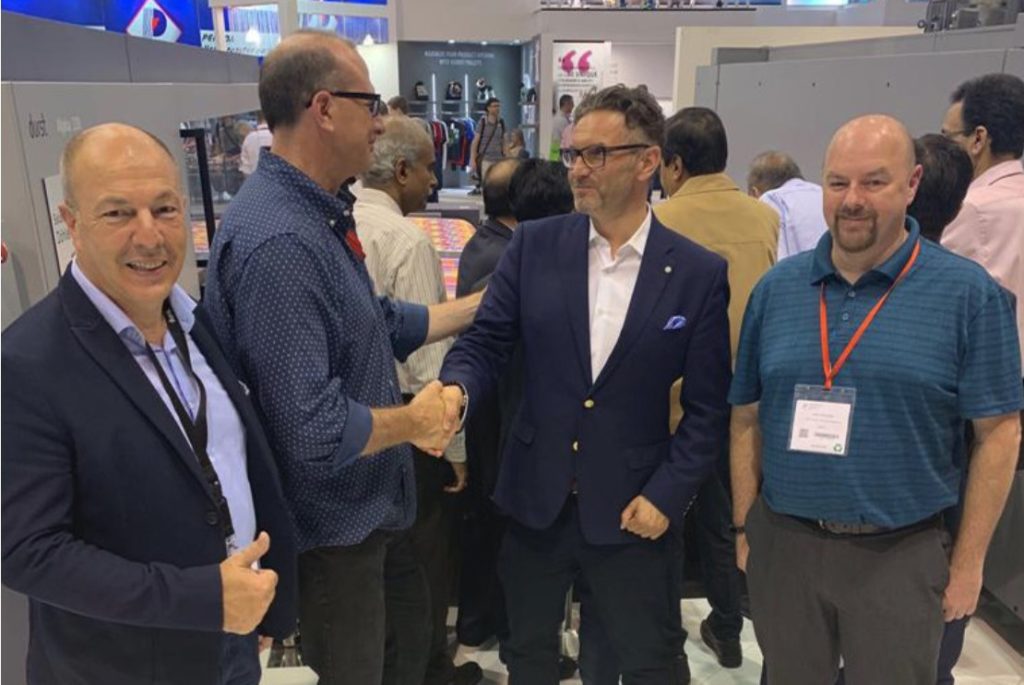
Durst to unveil more groundbreaking innovations and show live demonstrations of the updated Tau RSC portfolio at Labelexpo 2019

Brixen, Italy / Brussels, Belgium – 30.07.2019 – Durst, manufacturer of advanced digital printing and production technologies, will launch and present groundbreaking innovations and show live demonstrations of the updated Tau RSC portfolio – including the launch of a new model – on its stand C50 in Hall 9 at Labelexpo 2019 in Brussels, Belgium, from 24-27 September.

Introduced two years ago, the Tau 330 RSC and Tau 330 RSC E UV inkjet single-pass presses set new benchmarks in the label industry with already more than 50 installations all around the world. Visitors will be able to have a close look at the technology and different applications used by customers. New features such as a special high opacity white and high speed white print mode are helping to boost the performance and range of applications for customers.

The focus on the booth will also be on the new software portfolio offered by Durst Professional Services. New features of the Durst Workflow Label combined with the Durst SmartShop and integration packages help to fulfil Industry 4.0 standards to drive the Tau RSC portfolio.

Helmuth Munter, Durst’s Segment Manager, Labels and Package Printing, said: “We are really looking forward to Labelexpo 2019 where we will be unveiling more groundbreaking innovations. This will include new software and the expansion of our updated Tau RSC portfolio that will set the base for the future of industrial digital inkjet printing.”

Full details will be officially unveiled at Durst’s press conference in the Press Office Theatre at Labelexpo, Brussels, Belgium on Tuesday, 24 September at 14.15 to which you are invited.

Read More

PRESS RELEASE – University of Sheffield becomes one of the first UK recipients of new additive manufacturing technology by Desktop Metal


  • The University of Sheffield, working with Tri-Tech 3D, to install latest Desktop Metal Studio Systems
  • New system enables printing of a wider range of components to higher resolution finishes, at reduced costs
  • Desktop Metal Studio System provides on-demand metal 3D printing that can deliver scale and flexibility for diverse engineering needs

JUL 17 2019—BURLINGTON, MA, SHEFFIELD, UK: Two leading manufacturing centres of excellence in the UK have been named as the first to install a transformative additive manufacturing technology, developed by Desktop Metal, a company committed to making metal 3D printing accessible to global manufacturers and engineers. World top 100 academic establishment the University of Sheffield, and global engineering solutions firm Weir Group, are the first UK organisations to implement the Desktop Metal Studio System, working with UK reseller and platinum partner Tri-Tech 3D.

The Studio System is designed to provide an office-friendly metal 3D printing solution that can allow for rapid prototyping at low volume and cost, while providing users with the ability to efficiently produce tooling, jigs and fixtures, features which were previously cost prohibitive. The Studio System has already had a major impact on the additive manufacturing arena, with companies such as Ford, Google ATAP, Goodyear, BMW Group, John Zink Hamworthy Combustion and ProtoLabs, all becoming early adopters of the platform and attracting encouraging interest from fast followers. Based on 2019 worldwide benchmarking data collated by Desktop Metal, many parts produced using the Studio System demonstrated drastic cost reductions – some by as much as 90% relative to machining and selective laser melting (SLM) – as well as speed in fabrication, producing parts in days instead of weeks or months.

The University of Sheffield is working with the Tri-Tech 3D team to install their Desktop Metal Studio System at the Royce Translational Centre. Royce@Sheffield is part of the University of Sheffield’s Department of Materials Science and Engineering and is a major partner of the Henry Royce Institute for Advanced Materials. It comprises the Royce Translational Centre (RTC), and the Royce Discovery Centre, which is currently being built at the University’s city centre campus.

Royce Translational Centre’s Director – Prof Iain Todd, commented:

“We at Royce@Sheffield are very excited to receive our Desktop Metal Studio System. Additive Layer Manufacturing (ALM) is a critical part of the strategy for many high-value manufacturing sectors, as they look to reduce material waste and increase productivity. ALM covers many technologies, and with the Studio System, we are expanding our set of advanced 3D metal printers, which already includes electron and laser beam powder beds, and blown powder methods. Our industry partners range from start-ups to multinational aeronautical manufacturers: for them we represent a valuable missing link between small-scale laboratory metals processing and industrial scale manufacturing. The Desktop Metal Studio System keeps us at the cutting edge of near-net shape manufacturing capabilities in the UK.”

Weir Group Head of Additive Manufacturing – Sozon Tsopanos, commented:

“The additive manufacturing arena is dynamic, growing rapidly as a market, and presents exciting opportunities for innovative companies such as Weir. We are continuing to partner with world-class organisations as we proactively develop our additive manufacturing offering. The addition of this versatile system complements our existing capabilities at Weir Additive Manufacturing Solutions, allowing us to explore, prototype, test and commercialise components and tooling that will deliver significant benefits for our Mining and Oil & Gas customers globally.”

Since its founding in 2015, Desktop Metal has rapidly grown to become a leading systems developer for additive manufacturing technologies, with the Studio System attracting business interest all over the world. Tri-Tech 3D, the authorised UK Desktop Metal reseller, is targeting the rollout to other UK installations in 2019 and beyond.

Colin Cater, sales manager at Tri-Tech 3D commented:

“These first installations lead the way in a new direction for metal 3D printing, making metal parts available and more accessible to a wider range of customers. It complements all those currently using FDM, that require a metal part instead.”

Read More

Durst Analytics


Durst Analytics is our browser based solution to analyze the production data and to monitor the printing systems,
including productivity and print job statistics, daily production figures and critical issue monitoring to prevent down time risks. 

With Durst Analytics+ you can also combine several printers and send the data to your ERP or MIS system.

Read More

Three tales of 3D printers prove how diverse this technology can be.

By Kiersten Wones

We could print you if we wanted to – in one piece,” Matt Cone of Cameron Advertising Displays (Camad) told me as he described his company’s 3D printing capabilities. Camad came to 3D printing as a large-format printer in search of a way to excite both new clients and existing ones. Titanic Design approached the technology from the perspective of a manufacturer. WhiteClouds started as a media company, but suddenly found themselves with clients looking for 3D-printed models. But no matter the journey, what I really wanted to know was: How will this innovation change the way we think about the business of visual communication?

THE ‘WOW’ FACTOR

The folks at Camad (Scarborough, ON, Canada) had been screenprinting for nearly 60 years and large-format digital imaging for nearly 15 when they were approached by Massivit 3D. “When we were being pitched, we probably sat there and scratched the backs of our heads,” said Vice President Dan Deveau, “but once we saw the press, we just knew.”

Cone wasn’t joking when he said they could print me in one piece. The Massivit 1800’s capabilities span up to 57 x 44 x 70 in. “It was a great opportunity to dive into something nobody else was doing,” said Cone. Camad began operating the Massivit in June 2018, but the learning curve was skyscraper steep. From beginning to end, 3D printing is just a different type of journey.

It starts with a sales call, of course, and according to Harky Aulak, account executive, “It’s a completely different sell.” In some cases, you’re calling on new business; in others, you’re having a new conversation with longtime clients. Often, your clients have to pitch the idea to their clients. “What it’s forced my sales guys to do is circle back,” Deveau said. “This is something that has to be nurtured and coddled and miniatures done; there’s a whole new conceptual thing that needs to be understood by all parties.”

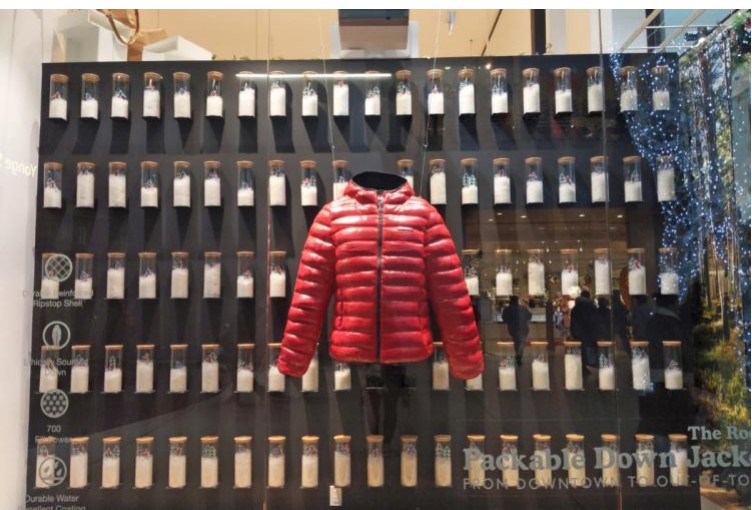
Camad 3D-printed this jacket for Roots, a nature-inspired clothing retailer in Canada.

So what makes all the back and forth, the patience and the intensive customer education worth it? “The wow factor,” said Cone. “Everyone that we presented to said, ‘Wow –could see us doing this,’ or ‘I could see us doing that.’”

The wow factor is just what Roots, a national retailer of nature-inspired clothing, was looking for when they said “yes” to a 3D project with Camad. The ask was simple: a 48 x 26 x 48-in. replica of a jacket. The production was straightforward, as well; Camad scanned the “real” jacket with a 3D scanner to create a 3D file. They printed it on the Massivit and then scanned the original jacket again for color. Camad then printed the solid color onto 3M Controltac IJ180Cv3 vinyl via an EFI VUTEk HS100 Pro and wrapped the 3D-printed model.

The jacket-model hung in Roots’ flagship store in Toronto’s Eaton Centre for a few weeks before Aulak received a call: “We sold out of those jackets. Can you take it down and re-wrap it in another color?”

“Well, absolutely,” Aulak said, so they scanned the jacket again, printed it red, and “up it went.”

“We can’t tell you that it’s the 3D jacket that made them sell out,” Aulak said, “but [they] certainly sold.” Roots has 180 locations around Canada – a new challenge for the Camad team.

ADAPTABLE IS EVERYTHING

In 2019, the word “success” is often synonymous with “adaptable.” WhiteClouds (Ogden, UT) is a prime example of adaptability. The business actually originated six years ago as a media company. The plan was to write articles and tutorials about 3D printing. WhiteClouds’ founders had experienced success with other media web properties; 3D printing was the cool new thing, and it seemed like a solid plan.

But before long, folks discovered that WhiteClouds had a few 3D printers behind the scenes – a Maker-Bot Replicator and a 3D Systems Cube – and suddenly engineers and designers were coming to the company for print jobs. “We realized there was more of an opportunity in becoming a print shop versus a media company,” said Cris Fowers, who heads up WhiteClouds’ marketing and business development, and was a part of the company’s founding team.

WhiteClouds settled into a few niche industries: architectural modeling, medical modeling and the world of tradeshows and events. As they produced larger and larger pieces, they realized perhaps 3D printing works best in tandem with other manufacturing processes, and suddenly they had a woodshop complete with laser engravers, CNC machines, foam cutters and more.

The welcome display for this year’s Consumer Electronics Show (CES) was a perfect example of different processes converging. Freeman, the company that manages CES, came to WhiteClouds with 2D artwork and a vision for a welcome display that would capture the spirit of the event and serve as the perfect selfie backdrop for attendees.

WhiteClouds produced this welcome display for the 2019 Consumer Electronics Show.

After formulating a plan that incorporated a 2D backdrop and a 3D display to accommodate the client’s budget, the Freeman and WhiteClouds teams set to work making 3D-ready files. WhiteClouds uses Autodesk Maya for prepress operations. The team elected to 3D print most of the figurines in the display – 11 pieces in total – with the exception of a game controller and the stage.

It was no easy feat; the final display spanned 18 x 6 ft. and required eight weeks of production. WhiteClouds used Creality 3D printers with PLA plastic, and a MultiCam 1000 CNC router. Most pieces were sanded, primed, bonded, sanded again and airbrushed with Createx paint.

As for the decision to print some pieces and cut others out of foam, Fowers said the game controller seemed like a simpler shape that would’ve been more expensive to 3D-print. But after finishing was more tedious than expected, the team wondered if 3D printing would’ve been the more efficient way to go. “The one thing about our industry is pretty much everything we do is a one-off,” Fowers said. “We take our past experience and try to make good decisions.”

ONE PROBLEM AT A TIME

Titanic Design (Mountain View, CA) is a large-scale 3D printing company established in 2016 when its founders saw a need for affordable 3D printing, particularly in the world of engineering. When I asked Tom Price, director of engineering and operations, what kind of clients a company like that serves, he said, “They have a problem that they need solved and they’ve heard 3D printing can help them.”

The problems Titanic has solved range from prototypes for groundbreaking sound-abatement technology to a 7.5-ft.-tall turbo fan engine to be used as a tradeshow prop. “3D printing is just another tool,” Price said. “The challenge is seeing where it works and where it doesn’t work.” He added that 3D printing, especially at this scale, is great for projects that are particularly unique, intricate or difficult to fabricate. Titanic commands a fleet of house-modified 3D Platform printers that can each churn out more than 35 cubic feet.

As for signage, the Titanic team decided to create a 3-ft., in-house display piece that would both test and show off their capabilities. “What would we be without a 3D-printed sign as a large-scale 3D printing company?” Price said.

The two-day job began with Titanic’s engineers adapting the company logo via Solidworks CAD software, but the plan wasn’t as simple as “print a logo and hang it up.” (It never is, is it?) The logo was engineered to print in two shell-like pieces in order to create a stand-out, backlit effect. The back piece is transparent and houses LEDs, and the front piece is teal. The sign looks as if it’s standing off the wall. Titanic used compostable, US-made bioplastic from Push Plastic.

Titanic Design created this in-house piece to display their 3D printing skills.

“I claim signage has some art to it,” Price said. Surrounding the logo element of the sign are functioning gears, which show off 3D printing capabilities, but are also a way for the Titanic team to test how well 3D-printed parts can hold up over time. The sign was hung in late 2018, and so far, so good.

What does 3D printing mean for the business of visual communication? Price reiterated his mantra that 3D printing is just “another tool in the toolbox. We by no means would say you should 3D print everything. You’re always going to have areas [in which] 3D printing can never compete – and I say that as a 3D printer,” he said. Titanic often collaborates with other fabricators, and Price added that traditional methods are still irreplaceable in many ways.

“It comes with an investment in people,” Price continued, pointing out that the engineers and technicians are who make or break this kind of work. And at the end of the day, isn’t that the beauty of it all?
Read More

Durst at forefront of evolution for digital production in textile printing

Brixen, Italy – 09.07.2019 –

Durst, manufacturer of advanced digital printing and production technologies and at the forefront of the web-to-print revolution in fabrics, has affirmed its technological commitment to the dynamic textile industry with prestigious deals in key growth sectors across the world.

Leading the web-to-print charge and located at the crossroads of digital textiles and e-commerce is Spoonflower, the US online community that has built its bedding and table home décor business around Durst’s pigment technology on the Alpha platforms. It has chosen to invest in two more Durst Alpha 330 Series 5 with pigment – one for North Carolina, USA, and the other in Berlin, Germany – to support its adoption of eco-friendly digital textile printing technology.

Spoonflower allows individuals to design, print and sell their own custom-designed fabric, wallpaper, and home decor products. The Spoonflower marketplace hosts the largest collection of independent fabric designers in the world, with over 1 million designs available to suit every taste and style. With environmentally sustainable on-demand manufacturing, no minimum order requirements, and zero finished goods inventory, Spoonflower exemplifies an integrated “pixel to output” approach.

Gart Davis, who co-founded Spoonflower in 2008, said: “Spoonflower is not just a service for custom fabric printing, we are a community that prizes individuality, self-expression, and a human connection between designers and those who want to bring design into their homes.  Pigment printing is a future technology that we use today thanks to the hard work and strong partnership with Durst. Our collaboration on home decor has been successful; the Alpha produce beautiful fabric with a precise, fine print, a broad gamut, and strong fastness properties, which is why we have invested in two more pigment Alpha 330s.“

Christoph Gamper, Durst CEO and Co-Owner, said: “As a pioneer in the web-to-print for fabrics, sustainability and pigment sectors our technology platforms represent the “new” textile. It’s not only speed but clever solutions too. The world needs more companies that question the status quo. We’re at the forefront of the evolution that will sweep across the textile industry. This is just the beginning.”

The Alpha 330 Series 5 is the fifth generation of Durst’s Alpha printing systems. It features newly-developed software to meet the increased demands of textile digital printing as well as improvements in material handling, efficiency and material diversity. The technology platform offers a sustainable, flexible and scalable solution for every application and enables waterless one-step production with Durst Advanced Digital Pigment ink. SuperMultipass™ provides 30% better performance than comparable systems by integrating new technologies in the printheads, inks and drying units. The Alpha Series 5 can also have a patented SwiftJet Pretreatment System positioned upstream of the Alpha printer – valuable for short-run and fast-turnaround jobs.

A family-owned company with a history stretching back more than 80 years, Durst Group’s values are focused on innovation, customer orientation, sustainability and quality. The US division of Durst, which is based in Rochester, is a full-service subsidiary and highly integrated service provider.

Backed by consultancy and seamless integration provided through Durst Professional Services, all systems can be equipped with the new Durst Workflow Print, monitoring tool Durst Analytics and Durst Smart Sh

Read More

It’s all about engineering!


Thirty kilometers north of Boston, $438 million seems to have disrupted the usual flow of time in the business world: Just three years old, Desktop Metal already employs around 270 highly qualified engineers at its enormous single-floor facility. “You can develop a lot of technology this way”, explains co-founder and CEO Ric Fulop. When you listen to Fulop’s ambitious plans with Desktop Metal, it seems that a tech giant is set to leave childhood behind, skip its teenage years, and make big strides in shaking up the market for industrial metal production.

Desktop Metal’s headquarters are located in a young industrial area of Burlington, Massachusetts. The 80,000-square-foot building is packed with numerous departments for the development of printers and furnace and debinding units. Here, laboratories and material testing facilities operate in close proximity to an area only accessible to select employees, behind whose doors the concepts for the company’s next product lines are created.

“Everything is product development, engineering and R&D. We outsource as much as we can.”

In an open-plan office of remarkable size, engineers work almost elbow-to-elbow, many of them with electrical components, circuit boards, or other components right there on their desks. A collection of innovation trophies and technical journals adorns one wall, but attracts little notice from the employees here – probably because their PCs or laboratories have more exciting tasks to offer. Somewhere, a foosball table serves as a reminder that a little more than three years ago, Desktop Metal was a start-up with just 11 employees.

Ric Fulop in one of the development departments at Desktop Metal. Photo: Thomas Masuch

About 40 months and several investment rounds totaling $438 million after its foundation, Desktop Metal can boast of hundreds of reservations for its two systems in both the United States and the rest of the world. The company has been shipping its Studio System to large numbers of customers in the U.S. since late 2018 (the first was shipped to Google’s ATAP in December 2017). “The Production System for mass manufacturing will see broader shipments in 2020”, reports Lynda McKinney, Head of Global Communications. While Desktop Metal does not reveal its exact sales figures, CEO Fulop is proud to announce that the company has now caught up with the world’s leading manufacturers of metal 3D printers in terms of delivery figures and is setting its sights on becoming number one.

CLOSELY ALIGNED WITH TECHNOLOGY COMPANIES

Desktop Metal’s ability to become a global player in the AM world in just three years has also been due to investments that are currently only being made in the U.S. From the outset, Fulop has thus formed an organization that is closely aligned with technology companies from Silicon Valley. ”That $438 million has allowed us to engage in product development that very few players can do”, Fulop adds.

Of Desktop Metal’s 300 employees, some 270 are engineers. All its internal departments apart from product development – including marketing, manufacturing, HR, and accounting – have either been boiled down to the required minimum or outsourced entirely. ”Everything is about product development, engineering, and R&D; we outsource as much as we can”, Fulop explains. The company’s service providers and outsourced areas are overseen by channel managers.

THE CHANNEL PHILOSOPHY

These channel managers also coordinate Desktop Metal’s sales efforts, all of which are handled by 90 sales partners in 48 countries. According to Fulop, ”this is a big advantage compared to having a conventional sales department because a very small team ensures that we have 1,400 sales people on the streets, selling our products”. In Germany, for example, Desktop Metal is represented by the AM specialists Solidpro, Alphacam, and Encee. Fulop explains that channel sales are the better solution in the long term while citing the CNC industry, where this form of sales and service is becoming more and more popular. The manufacturers of plastic 3D printers have also gradually switched to this technology in order to achieve higher quantities. In the metal sector, Fulop sees Desktop Metal as the first company to have built a channel. ”All AM laser manufacturers manufacture and sell directly”, he points out.

”WE’RE A TECH COMPANY”

According to co-founder Fulop, its strategic organization clearly distinguishes Desktop Metal from traditional industrial companies. ”For a tech company, the key differentiator in the U.S. is that you just focus on your core competency and outsource everything else”, he says. ”Our core competency is developing products and making things easier to use. That’s the main difference to the European model, where companies are used to doing everything”.

When Ric Fulop talks about Desktop Metal’s strategy, he often makes comparisons to Apple or Google. The Boston entrepreneur only mentions the company’s competitors in additive manufacturing to point out differences – as if the other established AM companies out there were already old-fashioned. Fulop is convinced that »his« business model will prevail in the long run. «It’s superior to the traditional approach,” he asserts.

For the production of its equipment, Desktop Metal cooperates with companies like Jabil, a contract manufacturer with $20 billion in annual turnover. Jabil produces according to Desktop Metal’s specifications and delivers directly to its channel partners. Desktop Metal employees are embedded in the supply chain to monitor the corresponding production quality. We do all our manufacturing the same way that Apple, HP, or similar companies are doing it, Fulop reports, who goes on to describe its manufacturing partners as best in class and capable of raising Desktop Metal to another ”level of excellence”. It’s clear that this is the right path for modern companies. ”With the traditional model, you do everything, but don’t excel at anything – and you’re very slow”, Fulop reveals.

IT’S A DIFFERENT TECHNOLOGY

”Additive manufacturing in the metal sector is currently too slow, too inaccessible, and too complex for mass production,” Fulop continues. When he talks about current additive metal production, he means the powder bed process. By comparison, a binder jetting process like the one used by Desktop Metal is many times faster. When this is combined with material costs that are 80 percent lower, Fulop says that additively produced components become significantly cheaper; in fact, he anticipates manufacturing costs of less than $50 per kilogram, while powder bed components would cost 10 to 20 times as much. ”It’s a different technology” he says, ”one that is giving rise to new areas of application – in the automotive industry, for example, where »seven of the top 10 car makers are using our technology”. For this price-conscious sector, cheaper AM production is obviously a future field, as BMW and Ford’s investments in Desktop Metal indicate.

According to Fulop, another advantage of binder jetting relates to the experience the industry already has with MIM technology. This process is used in automotive and electronics applications, and ASTM standards for binder jetting already exist. »We’re standing on the shoulders of giants,« Fulop admits. ”Big customers are familiar with the microstructures that come out of our machines, so there’s an immediate sense of understanding from the customer base”.

Fulop is certain that Desktop Metal’s technology will be broadly adopted. ”I think our technology will outsell laser powder-bed fusion in terms of units in 2019”, he affirms.

FOUNDERS AND EMPLOYEES WORKING SIDE-BY-SIDE

At Desktop Metal’s open-plan office in Burlington, co-founders like Ric Fulop and Jonah Myerberg can be found working among the rows of PC workstations. The company’s founding team of MIT professors and material and engineering experts knew Fulop from other projects or from his studies in Boston. Myerberg, for example, had already worked with him at the nearby battery company A123 Systems.

As an investor and tech entrepreneur, Fulop spent many years building up young technology companies. ”We invested over $130 million in various companies”,he says. Fulop was also one of the first investors in the AM company Protolabs. ”The company is now worth $3 billion, so that was a good investment,”he concedes with a smile.

It was in 2011 that Fulop – whom Forbes magazine describes as a »charismatic serial entrepreneur« – first came into contact with metal AM, at which point he decided to »make the complex process and technology cost-effective « From 2012 to 2015, he brainstormed with contacts he had made over the years. The result: We developed a fast new approach to binder jetting that we call single-pass jetting”, Fulop explains.

While Fulop’s old contacts have certainly not hurt our search for investors, the product does the talking in the end. In addition to strategic investors such as BMW, Google, and Ford, Desktop Metal has received support from major venture capital firms like NEA and Kleiner Perkins. ”We all share the same vision of where we want to take the company,” emphasizes Fulop.

For Ric Fulop, Desktop Metal is different from his previous investment projects. He has no exit strategy this time, either. ”The plan is to stay here for the next 20 years. That’s longterm – none of us have other plans”, he adds. To underscore his commitment, Fulop also describes how he withdrew from all his previous positions upon getting involved with Desktop Metal. He feels comfortable in additive manufacturing, and like in his previous investments, he remains active in advanced production. ”That’s kind of the area I enjoy”, he offers in summary.


https://fon-mag.de/highlight-stories/2019/desktop-metal/?L=1&fbclid=IwAR1t6bW7W54oupSrtPixJQhS9-hUaq5wTxWUa6sBSQQcogweuJtQfcfBSy4


Read More

Print Shop Generates Additional $1 Million with 3D Printing

3D printed beer bus shelter with 3-foot beer bottles printed in 10 hours per pair.

Print shop, Media Resources, credits large format 3D printing for their annual revenue increase of $1 million. The veteran PSP has leveraged the technology in order to evolve their offering to suit the changing market. This Canadian company had been seeking out new avenues of profit, pushed by co-owner, Steve Gallow, and given the ever-present challenges of product commoditization. They found what they were looking for, seeing an amazing return on their investment in a Massivit 3D printer. Mr. Gallow has many insights about the market, especially what it was like being an early adopter of large format 3D printing.

Fighting Commoditization with 3D

Steve Gallow often describes his experience of being an early adopter of digital printing as stumbling upon a lottery ticket. While he reaped the reward for a while, eventually the market would catch up and offer intense competition. That slowed his revenue, turning it into a “scratch off” lotto ticket. Eventually it trickled down to just trying to make a little money on razor-thin margins.

“Due to commoditization, services like digital vinyl printing that used to be charged at $12 per square foot are marketed today at just $0.65 per square foot!” bemoans Gallow. Bringing in a large format 3D printer has helped Media Resources evolve their business and control their profitability to a much higher degree. Being one of the first owners of a Massivit 3D printer in Canada, they can set their own prices while offering services that simply don’t exist elsewhere. It’s a huge move that is already paying off.

New Technology Spurs Growth

As one of the first owners of a digital printing press, Gallow understands how the excitement of a new technology can grow into an outstanding business opportunity. He had experienced how digital printing had been received and instantly understood what he had on his hands. “The hype, the media attention, and the way that the market grew was unbelievable,” he said in a recent webinar.

More than a decade later, Gallow felt the exact same when seeing a Massivit 3D printer creating displays and models in real time at a conference. He described the moment of seeing over a hundred people crowded around this huge machine, and the awe of what it was creating right there in front of them. If Media Resources was to expand out and find new profit sources, this was a prime opportunity. Only a month later, their very own Massivit 3D printer arrived at their facility. Its combination of size, speed, and creative freedom has enabled them to dive into new markets. Where they had trouble breaking into the movie industry, for example, it has now become 50% of their business. They’ve since entered other sectors, such as sports events and museums.

3D Printed Spiderman For Exhibitions,Events,Entertainment 3D printed Spiderman prop for exhibitions, events, entertainment. 

26Foot Paul Bunyan Prop For“IT”Movie,Based On Stephen King’s NovelPaul Bunyan prop for “IT” movie, based on Stephen King’s novel

Increasing the Bottom Line

While you can argue about the overall effect of making a big change to your business, you can’t argue about the data. “In our first year, we’ve added $1 million in extra revenue related to 3D displays, signage, and props,“ Gallow explains. That’s the type of return on an investment anyone would be happy with, and it is only the start as leads are streaming in.

“The hype this technology drums up is phenomenal. We used to get one lead per month through our social media channels, but since purchasing a Massivit 3D printer, now we’re getting an average of 3 leads per day,” he gushed. That’s an astronomical increase, and it is brought about by having a product offering that is so new and exciting, as well as being effective. Leveraging the buzz around large format 3D printing has done wonders for their numbers.

Conversation Starters That Close

PSPs are also noticing that the technology is a great conversation starter. “3D printing gives us another reason to pick up the phone and talk to customers,” Gallow confided. “It’s the most exciting part of our presentation to our clients.” When the enthusiasm is palpable both on the part of your own salespeople and your clients, great things happen. These conversations can quickly escalate into sales, as clients realize the immense possibilities that large format 3D printing brings.

Samsung Illuminated Stylus Pen POP Display1Samsung illuminated stylus pen POP display. 


Samsung Illuminated Stylus Pen POP Display2Samsung illuminated stylus pen POP display. 


As Mr. Gallow explains further, “It inspires the advertising agencies to experiment with new ideas as well, and then they approach us and ask ‘So does this mean you can do this?’ It is helping to start exciting, new conversations.” From a look at their early and consistent success, Media Resources has been able to turn these conversations into closed deals, and have changed the way they do business, period.

For a deeper look into how print services are growing their business with large format 3D printing, be sure to read the Ebook, 5 Reasons to Incorporate 3D Printing into your Wide Format Digital Print Business.  

About Massivit 3D

Massivit 3D Printing Technologies Ltd. (www://massivit3D.com) is a pioneer of large format 3D printing solutions for visual communication spanning the advertising, retail, events, entertainment, interior design and architectural sectors. Leveraging its proprietary Gel Dispensing Printing (GDP) technology, the company’s solutions enable rapid and cost-effective production of super-sized, eye-catching 3D signage, displays and props. Massivit 3D’s mission is to enable print services and other visual communication producers to expand their business offering, gain a competitive edge, and generate new sources of revenue. Founded in 2013 by a team of recognized 2D and 3D printing experts, Massivit 3D provides its worldwide community with end-to-end services supported through an extensive dealer network.

Read More

Desktop Metal Now Shipping the World’s First Office-Friendly Metal 3D Printing System to Companies Throughout Europe

PRESS RELEASE – Desktop Metal Now Shipping the World’s First Office-Friendly Metal 3D Printing System to Companies Throughout Europe

JUN 20 2019—Desktop Metal, the company committed to making metal 3D printing accessible to manufacturers and engineers, today announced it has begun shipping its Studio System™ to customers and resellers throughout Europe. The world’s first office-friendly metal 3D printing system for functional prototyping and low volume production, has met with strong adoption in North America among leading companies, including Ford, Stanley Black and Decker, Google’s ATAP, Goodyear, Owens Corning, and John Zink Hamworthy Combustion. Building on that momentum, the Studio System is now CE certified for international compatibility and being installed at customers throughout Europe, including France, Germany, Greece, Italy, Portugal, Spain, the Netherlands, and the United Kingdom.

“When Desktop Metal first launched, we set forth a mission to fundamentally change how the world designs and produces metal additively manufactured parts, from functional prototyping to mass manufacturing,” said Ric Fulop, CEO and co-founder of Desktop Metal. “We have been delivering on that vision throughout the U.S. and Canada, and are now ready to step onto the global stage to further accelerate our business expansion and answer the impressive demand of the European market.”

In anticipation of the international expansion, Desktop Metal has been working for more than a year with a select group of strategic customers as early stage evaluators of its technologies. These strategic partners have been a source of key user feedback on benchmark parts, materials, training and system usage. International customers of the Studio System span multiple industries, including automotive, education and defense, as well as service providers of luxury brands and consumer products. Leading companies, including BMW Group in Germany; Politecnico Di Milano, one of the largest technical universities in Europe and Additive Italia srl (Add+It) in Italy; EGIBIDE and Centro Avanzado de Fabricación (IMH) in Spain; Edalis, Soprofame and MSA in France; Weir Group and the University of Sheffield in the UK; Jade Groupe of Portugal, which specializes in metal parts production for the luxury fashion world; and BAZIGOS of Greece, a manufacturing firm specializing in high precision components, are among the first customers to benefit from the ease of use and accessibility provided by the Studio System.

Studio System for Metal Prototyping and Low Volume Production

The Studio System is designed to make metal 3D printing more accessible, enabling design and engineering teams to print metal parts faster, without the need for special facilities, dedicated operators, or expensive tooling. The three-part solution, including printer, debinder and furnace, automates metal 3D printing by tightly integrating through Desktop Metal’s cloud-based software to deliver a seamless workflow for printing complex metal parts in-house—from digital file to sintered part.

To date, Studio Systems worldwide have fabricated more than 10,000 parts, with applications ranging from functional prototyping of extruder nozzles and shock absorber pistons; to jigs & fixtures, including robotic end effectors and smartphone fixtures; to manufacturing tooling of zipper molds inserts and extrusion dies; and low volume production of gears and motor mounts. Each of these benchmark parts has shown drastic cost reduction – some by as much as 90 percent relative to machining and selective laser melting (SLM) – as well as speed in fabrication, producing parts in days instead of weeks or months.

Early Customer Applications and Highlights

Customer feedback on benefits companies can now achieve include:

  • Built to Scale: The Studio System offers a 10 times larger sintering volume than competitive systems, which enables cost-effective, low-volume production of metal parts. One Studio furnace supports up to five printers, allowing for batch processing for high throughput.
  • Superior Parts: Mechanical properties, material properties, surface quality, feature fidelity, geometry, size, dimensional accuracy – the Studio System considers each of these critical factors with expertly engineered features to ensure great parts.
  • Safe for the Office: A key differentiator of the Studio System is that it prevents exposure of solvents to users and does not require external ventilation. The system is designed for use in a range of environments — office, lab, shop — making it easy for any engineer to make metal parts in-house.


France:

  • Edalis, a unique kind of industrial concierge, is a major player of 3D printing services in France, from project study to production,” said Nicolas Blanchard, Managing Director at Edalis. “Our design office and workshops allow us to deliver final end-use parts.Our choice to invest in the Desktop Metal Studio System is based on our willingness to continue innovating for our customers, complement our quality equipment installed base and be very agile thanks to the easiness and flexibility of this tool.”

  • Soprofameis a machining, precision engineering and additive manufacturing expert, for plastic and metal. “We decided to invest in the Desktop Metal Studio System in order to provide our customers a complementary solution to our machining expertise,” said Jean-Baptiste Frenel, Director at Soprofame. “This innovative technology will allow us to answer our customer needs with more effectivity and reactivity, bringing a real value added to our know-how and a differentiating offer in an ever-changing market.”

  • Founded in 1985, MSAis a recognized expert of boilerwork, welding and public lighting. “MSA chose to invest in Additive Manufacturing technologies to diversify these offerings and better answer customer solutions,” said Martial Champion, CEO of MSA. “The Studio System will allow us to produce in-house metal parts with a variety of complexities, with more speed and flexibility. Among other AM solutions, the Studio System was the easiest to implement and safer for our operators.”

Greece

  • “As a leading molds manufacturing company servicing the largest Greek and multinational customers worldwide that rely on high precision parts, the adoption of the Studio System is a dynamic complement to our expanding plastic and metallic parts production center,” said Mr. Manos Bazigos – Managing Director,  Bazigos SA. “In addition to rapid metal prototyping for customer products that range from domestic appliances, refrigerators, electric cookers, to lighting and locks, we also see tremendous opportunity for creating molds, jigs and fixtures as well as opening up the avenue of low volume replacement parts for our customers.”


Italy

  • Politecnico di Milano(POLIMI) is among the largest technical universities in Europe. In the specific area of Mechanical, Aeronautical & Manufacturing Engineering, POLIMI is ranked 1st in Italy, 3rd in Europe and 7th worldwide. “The Studio System completes the range of metal Additive Manufacturing solutions in our state-of-the-art AddMe lab,” said Bianca Maria Colosimo, Ph.D. Professor, Deputy Head of the Department of Mechanical Engineering for Research. “With the Studio System, we will be carrying out several types of research to explore novel solutions for additive manufacturing, including process modeling and optimization, benchmarking with other existing or newly-developed processes, in-situ monitoring and more.”

  • Additive Italiais a company specialized in simulation driven engineering and generative design focused on Additive Manufacturing for metals. “Add-it offers a unique complete consultancy for the analysis, development, prototyping and industrialization of metal components, based on Additive Manufacturing,” said Marco Preziosa, CEO. “We selected Desktop Metal technology as we see in this indirect metal 3D printing process the future of manufacturing, bringing speed, flexibility, cost-effectiveness and wide potential of materials choice. Also, Desktop Metal’s huge competencies on the software side will be a key asset to expand Add-it digital solutions.”


Spain

  • The Machine Tool Institute (IMH) is an Advanced Manufacturing Center that offers specialized training in Advanced Manufacturing (AM) and Technological / Organizational Innovation services for companies. “At IMH, we are constantly seeking new advanced manufacturing technologies to foster increased innovation among our students and business professionals in the Basque country,” said Xabier Cearsolo, AM Department Manager, Centro Avanzado De Fabricacion – IMH. “The Desktop Metal Studio System should quickly become a key educational and training tool for those in the IMH community who are looking to expand their metal 3D printing knowledge and remain ahead of the curve.”

  • EGIBIDEis a recognized school and training center with 75 years of experience. “Our goal at EGIBIDE is to connect our students with the most advanced tools and know-how of the society of the 21st century,” said Jon Uriarte, Educator. “We chose to invest in the Desktop Metal Studio System to be at the forefront of metal AM technology. Also, the cost per part and easiness to install and operate – no laser, no powder – will allow improved technology transfer to our region’s companies.”

In addition to shipments now underway in USA, Canada and Europe, the Studio System is available to reserve in 48 countries, including Asia Pacific, EMEA, and Mexico. To provide superior customer service, the company has a growing global network of 85 sales partners and resellers, all experienced in manufacturing equipment distribution. European customers submitting new orders can expect to receive their systems within eight weeks or sooner. Availability of the Studio System will vary by country and interested buyers should visit www.desktopmetal.com/international for more information.

About Desktop Metal

Desktop Metal, Inc., based in Burlington, Massachusetts, is accelerating the transformation of manufacturing with end-to-end metal 3D printing solutions. Founded in 2015 by leaders in advanced manufacturing, metallurgy, and robotics, the company is addressing the unmet challenges of speed, cost, and quality to make metal 3D printing an essential tool for engineers and manufacturers around the world. Since its inception, the company has raised $438 million in financing with a portfolio of strategic partners and investors including Ford Motor Company, GV (formerly Google Ventures), GE Ventures, BMW iVentures, Koch Disruptive Technologies, Lowe’s, New Enterprise Associates (NEA) and more. Desktop Metal was selected as one of the world’s 30 most promising Technology Pioneers by the World Economic Forum and named to MIT Technology Review’s list of 50 Smartest Companies. For more information, visit www.desktopmetal.com.

Read More

Durst Rho 512R LED impresses with quality and printing speed

Hruby, a business founded in Berlin Kreuzberg back in 1919, celebrated its 100th anniversary in April 2019 and, under its current name of Hruby Werbetechnik GmbH, is one of the most versatile businesses in Berlin, employing 25 people. The strengths of the team, which is led by third-generation managing director Fritz Naumann, include individualized consulting, flexibility, and implementing challenging products. Fritz Naumann started out at Hruby as a vocational trainee, learning the business from scratch and assuming responsibility for the company in 2010.

In 2019, Hruby Werbetechnik GmbH expanded its operations by adding a Durst Rho 512R LED at a second location in Berlin and has been impressed by the quality and printing speed. The intention is to cover new products and larger formats as well as driving the company’s philosophy of high customer satisfaction and diversity.

Read More

RAPID 2019: Metal 3D Printing Interview with Desktop Metal

At the recent RAPID + TCT event, held in Detroit, the 3DPrint.com team saw many new products and innovations and spoke with many companies about what they were currently working on. While at the show, I stopped at the massive Desktop Metal booth to speak with Larry Lyons, the company’s VP of Product. The company was founded four years ago in Massachusetts, and has 3D printed nearly 10,000 parts on its desktop-based DM Studio System, which was launched back in 2017 along with the DM Production System just ahead of that year’s RAPID event.

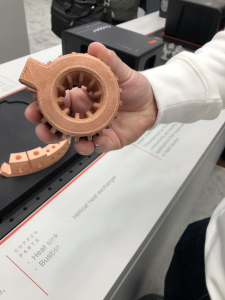
In the years since it came galloping onto the metal AM scene, Desktop Metal has been busy raising funds, increasing the production and expansion of its Studio System, and expanding its materials portfolio, adding options like 316 stainless steel, 4140 carbon steel, and copper. Lyons explained to me that it’s hard to control the laser melt pool when printing with copper which means that laser based 3D printing methods have struggled to print with the metal. Only some EBM users have made it work while very few (namely Italy’s Beamit) have made it work with DMLS. The issue is that the material is so conductive, but Desktop Metal is able to “print this material as fast as stainless steel,” compared to which it has better thermal conductivity.


Speaking of steel, the company is also offering H13 tool steel. Because this material is so tough, it’s often used for die mold making, but Lyons explained that lead times can be really long when making the molds with laser-based 3D printing systems.

“Desktop Metal can deliver the tool steel that customers want,” Lyons stated.

When I arrived at the Desktop Metal booth, I immediately noticed the metal 3D printed nametag that Lyons was wearing, which he told me was created on the company’s Studio System.

“DMLS is not cost-effective,” he said, noting that “Desktop Metal can show what the technology is really able to do with pieces like this [nametag].”

The company’s big mission at RAPID this year was to give attendees a closer look at some of the main customer applications of the office-friendly Studio System, and how it offers these customers more design freedom, in addition to major cost and speed savings.

First, Lyons told me that the company is installing its second Production System at a Fortune 500 company this month, and that millions of parts for use cases have been completed on the printer, including a drill bit that’s saved Milwaukee Tool a lot of money. Additionally, Desktop Metal announced during RAPID that it has entered into a strategic partnership with Indo-MIM, the world’s largest supplier of Metal Injection Molding (MIM) precision-engineered products. Together, the two plan to accelerate the adoption of metal 3D printing around the world, and Indo-MIM will soon install the DM Production System at its Texas facility.

But, while some Production customers allowed Desktop Metal to showcase some of their parts at the show, they “can be pretty tight-lipped about using their names.” Lyons said that this is not the case with Studio System customers – Desktop Metal has collected data and use cases on over 1,000 customer benchmarks to get a good feel for how these parts made on its machine are being used.

Several leading companies shared their Studio System experiences and applications with Desktop Metal, and the company reports that each one of the parts it’s looked at has shown a major reduction in cost, in addition to time. The top three applications customers are using the DM Studio System for are:

  • Functional prototyping – 45%
  • Manufacturing jigs, fixtures, & tooling – 40%
  • Low-volume manufacturing for end-use parts – 15%


Applications in functional prototyping require parts that meet specific chemical and thermal requirements, and most customers need prototypes to be fabricated in the same materials used for mass production. According to an email from Desktop Metal, John Zink Hamworthy Combustion manufactures the UHT Atomizer fuel nozzle, which is often used in combustion engines for steam propulsion boilers on LNG tankers. This nozzle can only be manufactured with 3D printing, and was redesigned to be more fuel-efficient; it was printed on the DM Studio System out of 316L steel, and then went through surface finishing for final use.

It can be lengthy, difficult, and costly to manufacture tooling like extrusion dies and inserts for injection molding using traditional machining. Jigs and fixtures made up 25% of the early applications on the Studio System, with tooling at 15%, as having the in-house metal 3D printing makes it possible to iterate and replace worn out tooling more quickly, which helps reduce tooling lead times.

Alpha Precision Group (APG), which provides MIM, valve assemblies, highly-engineered components, and powder metal fabrication, uses the DM Studio System to make fixtures that have to be able to continue performing after repeated uses.

Those who use the Studio System say it’s helping to enable low-volume production of pilot runs and custom, aftermarket, and replacement parts, for which methods like CNC machining and casting are not ideal. Mining equipment drilling solutions provider Master Drilling is using the metal 3D printer to produce replacement parts on-demand, and ended up with a 25% cost savings, in addition to reducing the lead time down from eight weeks to just one, for a sun gear made out of stainless steel.

Lyons told me that Desktop Metal is “moving past just medical and aerospace” applications, and is creating more automotive parts, in addition to products like a shower spindle for a hotel bathroom.

“We may not necessarily see these parts, but we touch many of them often,” he said.


Owens Corning normally uses Inconel to 3D print fiberglass insulation so that it can hold up in extreme temperatures, but Lyons explained that this material is costly and difficult to shape. With the DM Studio System, the company is majorly reducing the cost, and making it easier to create, these and other parts, including augers. Caterpillar is using the DM Studio System to help keep its tooling up to code, as it has a 40-year spare parts agreement with its customers; 3D printing parts like housings on-demand helps the company eliminate unnecessary overhead.

Then, Lyons walked me across the booth to meet Senior Software Engineer Andy Roberts, who created the company’s Live Parts generative design software. The Live Parts tool is designed to actually grow parts for AM, as well as integrate with SOLIDWORKS as a plug-in.

Roberts then demonstrated Live Parts, and its ability to optimize the strength-to-weight ratio of a product in real time, with a design for a skateboard truck. He explained how it was easy to increase the forces in order to see real-time part growth.

“A lot of parts, like this skateboard truck, are all cast, and cast parts typically are fairly simple – they don’t have a lot of undercuts and features that would require machining or post-processing,” Roberts explained. “But when you go to 3D print a part like this, there’s no need to adhere to the simplicity of that. You can make it lighter and stronger. The question is, how do you know what to do?”

Answering his own question, Roberts turned to a nearby computer, which had a design for the skateboard truck already pulled up in Live Parts. He later told me that it had only taken three minutes to “grow” the part.

“It’s literally growing this part in real time, as though it’s a living organism.”

He showed me one example of the truck where the team told Live Parts to grow the design inside the existing part, “like a cage,” but said that it wasn’t “very interesting.”

“And then we kind of let it go crazy,” Roberts went on. “We said, well, you can’t grow into the other parts, but when you let it really go and do its own thing, it gets much more organic. And so these become lighter and stronger, depending on the material you’re using, because it generally tries to push the material out far away from the core. It’s more like the way a tree would behave.”

Read More