Rondo, St Ruprecht an der Raab, Austria

We didn’t just buy a machine, we bought a whole system involving software, analytical tools and calculation tools, so we are very happy that we don’t need any additional software

Rondo’s digital transformation for its corrugated packaging business has been driven by brands who have opened their minds to the new wave of opportunities from sustainable production where flexibility and time to market are crucial driving factors.

Digital corrugated production is now going up by 25-30% a year for Austria-based Rondo St Ruprecht an der Raab, one of six plants in Europe for the family-owned Rondo Ganahl Group. The company specializes in corrugated board production using flexo, offset and digital technologies. It has never looked back since making a leap of faith two years ago and becoming one of the world’s first users of the Durst SPC 130 water-based technology.

Managing all data through the Durst workflow with its sophisticated color management, analytical tools and variable data creation, has made a strong and positive difference – all provided through Durst Professional Services.

Robert Posch, Operations Manager at Rondo St Ruprecht an der Raab, said: “We didn’t just buy a machine, we bought a whole system involving software, analytical tools and., calculation tools, so we are very happy that we don’t need any additional software. The brand Lindt & Sprüngli, as an example, has extremely dark and powerful red colours, as well as brown. With the powerful Color management features, we have been able to reproduce them accurately and we have matched their demands.”

Mr Posch added: “We are looking forward to working with Koenig & Bauer and Durst together because we see huge future potential with the software and what we hope will be the perfect printing machine. With experience of big industry, both Durst and Koenig & Bauer are excellent, robust engineering companies with world-class expertise. Certainly, we have had a very positive impression of the SPC 130 machine and from the staff right from the start.”

Karl Pucher has been the Managing Director at for Rondo St Ruprecht an der Raab for the last eight years. “We had been talking about getting into digital printing for a long time and for Rondo it was something new,” he said. “We had to change a lot of processes and took a lot of risk. We have made a lot of improvements in the processes. Sales are now racing ahead every month. Customers are making repeat orders, which is very important, so we are very happy that we took this decision. Our corrugated business is going up by around 20 to 30% every year and we see that this is a fast-growing business for the next years and soon we plan to go for a full three-shift operation. The share of digital printing was at first around 5 to 10% of our overall business, but we expect this to double within the next couple of years.

“It’s a known fact that brand owners were in love with the offset printing because of the quality, but since we have had digital printing we have transferred lot of offset business to digital because of shorter lead times, initiation costs and there is no difference in quality between offset and digital for many applications. Quality is extremely important for the brand owners, but it is not the topic anymore.

About 90% of the Rondo digital printing business is for the food industry. Brand owners have many more products compared to a few years ago and shorter lead times to market. “Lindt & Sprüngli is one example where we used to plan months ahead for Christmas, Easter and summer editions and needed to keep high levels of stock,” said Mr Pucher. “Now with digital technology we can be extremely flexible. Lindt & Sprüngli can create a new order that we can produce digitally and have in the shops within weeks.”

Mr Pucher added: “Digital printing is also providing answers for the global debate on the use of plastic packaging, which obviously extends to food and safety. Using the new food safety compliant inks in primary and secondary packaging means we can create corrugated board packaging to be used as an environmentally friendly alternative to plastic. The SPC 130 with its water-based technology from Durst is providing the solutions that we need to delivery to the food industry.”

Read More

Rospil’s total confidence in Durst leads to Tau 330 RSC E investment to capture new markets

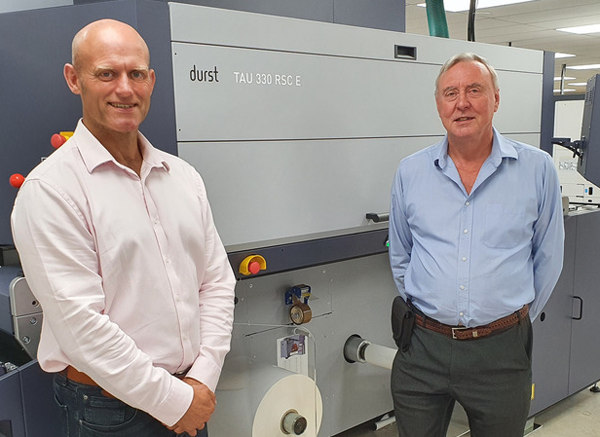
Madrid, Spain – 12.06.2020: Etiquetas Rospil has taken the next step on its digital transformation by capturing new markets with an investment in a Tau 330 RSC E from Durst, manufacturer of advanced digital printing and production technologies. Increasing numbers of its own customers are explicitly demanding that their labels are produced on the single-pass inkjet press.

Madrid-based Etiquetas Rospil has enjoyed unstoppable growth due to its strong customer focus and commitment to innovation. It became one of the first companies in Spain in 2013 to invest in digital ink-jet technology with Durst’s Tau 330/200 solutions, which produced more than 10 million linear meters. Etiquetas Rospil has now become the first company in Iberia to install the Durst Tau 330 RSC E. It improves versatility and provides faster order turnarounds to ease pressure on delivery requirements. Replacing the Tau 330, the machine also allows considerable ink consumption savings per linear meter.

Jorge Pérez, Deputy Manager of Etiquetas Rospil, which is celebrating its 45th birthday, also highlights the consistency of the color and brightness of the orders produced on the Tau Solutions. “Each year there are an increasing number of customers who demand explicitly that their labels are produced with Durst Tau technology,” he said. “It’s been unstoppable growth. Also, we are clear that the future of the sector is digital. That is why we decided to take a new step.


“We have full confidence in Durst. Our experience with them has been second to none. There is nothing comparable in terms of quality and reliability and, now with the new Tau 330 RSC E, neither in productivity. Furthermore, the technical assistance offered by Durst Ibérica is fully personalized.”

The Tau 330 RSC E combines best-in-class print quality with an economic investment and is fully upgradeable to an 8-color label press to provide increased capacity when production requirements increase. Etiquetas Rospil’s model is equipped with four colors plus white.

Mr Pérez said: “We know the future is digital and we will make new progress in the coming years. This is another advantage of the the Durst Tau 330 RSC E – it allows upgrades of productivity up to 80 linear meters a minute and add process colors to match our requirements. However, for now we are very happy with the current investment. In addition, we are already taking concrete steps in the Industry 4.0 transformation. This is the challenge we have to face in the coming years and by joining forces with a partner such as Durst in this transformation, we are encouraged to make further progress.”

Helmuth Munter, Durst’s Segment Manager, Labels and Flexible Packaging, said: “Etiquetas Rospil’s growth is a perfect example of how innovative and forward-thinking companies recognize the all-round benefits of our technology. We’re delighted to hear that its customers increasingly demand that their orders are produced on the technology. Our Tau RSC platform sets the base for industrial inkjet printing in the label industry. It offers a total package to all our customers in terms of high quality, the best possible service and resulting production reliability, as well as important cost-savings.”

Read More

How metal additive manufacturing will alter the automotive industry

In a recent interview with Jonah Myerberg, co-founder and CTO of Desktop Metal, we explored how metal additive manufacturing, including desktop printers, will affect automotive design and production.

Desktop Metal printers are used in a number of industries, with automotive one of the major ones. Ford and BMW were early adopters of Desktop Metal’s technology and have become investors. Mostly, these companies are using metal 3D printing in vehicle short runs but they have ambitions to move into mass production.

Here are some of Myerberg’s observations about the use of metal 3D printing in the automotive industry.

–AM is going to be both a tool and a game-changer. It’s a tool because it will be required to do a vehicle design job efficiently and competitively. Designers will need 3D printing in one way or another to be able to react quickly to customers and their demands, prototyping components and parts to change and innovate, as well as to produce low volume components, and to remain flexible for their customers.

–It will be a game-changer because it will enable specific needs for products like the electric vehicle for lightweighting.

–It’s also going to be a game-changer in that it will help equalize the field for small companies trying to compete with the big companies. The automotive industry will see a birth of new tier-one suppliers focused on AM. And it’s going to change the way that designers think about automotive design.

–Metal AM can be applied to any component within a car. Materials are available that tolerate the temperatures and offer the strengths of more traditional alloys used in the engines and suspension systems and transmissions. “We’re going to see additive manufacturing playing in every aspect of a vehicle,” noted Myerberg.

–The Circular Car Initiative. One focus of the world economic forum is how to make transportation systems more efficient and less impactful on the environment. Electric vehicles, hybrid vehicles, and hydrogen vehicles will play on that. But what’s not often thought about is the impact that the actual car itself will have once it’s reached its end of life. “All of the things done to make the car more efficient, such as low weight plastics, could become a problem. What do you do with those light weight plastic components at the end of a car’s life? You can’t melt them down and turn them back into plastic again,” he noted.


Metals can be almost endlessly recycled. The circular vehicle initiative is looking for answers and looking for ways to make vehicles fully recyclable. Some parts can be repurposed. Battery packs in electric vehicles reach a point where they are not useful in the vehicle, but they still have energy in them. Some are being used on the electric grid and will work for another 10 or 15 years. “This type of creative thinking is extending the lives of the automotive components, reducing the impact that the vehicle has on the environment after its death.,” noted Myerberg. “We’re going to see plastic components being replaced by metal components for that reason.”

Many of the complex assemblies inside a vehicle are assemblies of composites of polymers, or metal components buried within the polymer composites. “These complicated assemblies are ripe for that type of additive manufacturing that can step in, combine three, four, five, 10 parts into one and replace an entire system with single or multiple components that weigh the same or less, take up less space, and are fully recyclable. Also, such parts often require the use of injection molding machines to produce, which can be a huge investment on the part of the OEM or the tier one molder, especially if changes are involved,” said Myerberg.

For the engine compartment, now there are high strength, high-temperature polymers available. But metal materials offer higher ranges. Replacing plastic components with metal ones lets designers raise localized temperatures. Some vendors are looking into using metal to protect components or be combined with plastic components.

–One of the limitations of most 3D printers is the build size. “I’d love to say we can print a car chassis or body because these are hugely complicated assemblies that are very much static assemblies designed for crash and stability and stiffness, but with no moving parts, welded together. It would be fantastic to optimize a body into a single piece and print it. We’re not there, but we are certainly working on technologies that will get us there if that’s the end game. We want to see these parts grow out of the 3D printer in real size and real and in a single form.”

–Several 3D printers let designers place mechanical characteristics exactly where they want them. For example, one area can be flexible and a different area can be stiff. That opens up possibilities for engineers, enabling them to design a chassis as much for performance on the road as for manufacturability.

“To be able to design an entire vehicle at one time and then print it out and have it be optimized for crashing, impact, suspension, performance all in one, that’s really exciting, but we’re certainly not there yet. In fact, we’re up against current manufacturing processes focused around sheet metal. Products that require parameters like width, flatness, and low profile (for stamping) are not the easiest things to 3D print in metal. Sheet metal is not a friendly design and so designers, if they’re going to replace a sheet metal fabricated assembly with a 3D printed part, they will have to go back to the drawing board and redesign it under the loads that are being placed on it.”

One of the tools that will help such a redesign is generative design, because it uses AI to do the heavy lifting.

–Additive manufacturing is a bridge between concept and final mass production. “And we’re seeing that happen all over the place where some customers or some designers, they don’t have the time or they don’t have the money to invest in the tooling that’s required for the part, while 3D printing allows them to do that, they allow them to jump in and test a design without having to invest in that tooling.

–More than ever, additive manufacturing is affecting the supply chain, which will affect worldwide manufacturing. “We’ll be able to pull manufacturing back in, re-shore it into the United States, bring it closer to the point of manufacturing instead of have these long-distance supply chains.”

Read More

PostProcess Live Solution Experience

Sign up today for a PostProcess Live Solution Experience, a real-time group tour of automated 3D post-printing focused on key print technology applications. Conducted by an expert Engineer broadcasting from our lab, you will get a close-up view of how full-stack technology encompassing software, hardware, and chemistry works. See the solutions running live on the proprietary AUTOMAT3D™ platform and engage in real-time Q&A. Explore options for various sessions below! 

FDM & PolyJet


Your live tour of automated Support Removal and Surface Finishing for FDM & PolyJet

June 11th

June 18th

June 25th

Sign up now!

Resin Removal


Your live tour of revolutionary Resin Removal technology for SLA, DLP, CLIP and more

June 11th

June 18th

June 25th

Sign up now!

Read More

EnvisionTEC | 3D Printed Test Swab Production

EnvisionTEC is fulfilling orders for 3D Printed NP swabs for Covid 19 testing. During the clinical trials performed by BIDMC, the EnvisionTEC swabs received positive comments from study staff for comfort, flexibility, and ease of insertion.

Learn More
envisiontec.com/envisiontec-covid-19-efforts/

EnvisionTEC COVID-19 Efforts

Lorem ipsum dolor sit amet, consectetur adipiscing elit. Ut elit tellus, luctus nec ullamcorper mattis, pulvinar dapibus leo.

The 2020 COVID-19 pandemic has proven to be an opportunity for 3D printing to assist in finding new, innovative ways for healthcare professionals to provide assistance.  A shortage of the necessary diagnostic and treatment supplies has been discovered, and while many businesses have jumped in to help, it is 3D printing that may be able to provide real answers for how to combat the supply chain crisis.

Working hand-in-hand with healthcare leaders, EnvisionTEC has identified several areas where their specific strengths in biocompatible materials and fast, precise 3D printing equipment can help to provide replenishment of stocks as well as new, alternative solutions.


Learn more about these efforts below and find out where you can help, and how we can help you.

Latest Press Releases:

April 20, 2020 – BIDMC-led clinical trial identifies four novel 3D-printed swabs for use in COVID-19 testing – Link

April 15, 2020 -EnvisionTEC to 3D Print Mass Quantities of Nasopharyngeal Swabs for COVID-19 Testing Based on Successful Clinical Trial – Link

March 29, 2020 – EnvisionTEC Partners With Healthcare Community to Battle Global Pandemic – Link

Read More

3D Printing Shows its Strengths

Desktop Metal’s Jonah Myerberg on how 3D printing helps companies respond quickly during a crisis.

Additive manufacturing companies have been active during the worldwide pandemic and shutdown, helping health care providers and other companies address supply chain shortages. Digital Engineering spoke to Jonah Myerberg, co-founder and CTO at Desktop Metal, about the company’s activities and experiences during the COVID-19 shutdown.

DE: Desktop Metal has been involved in rapidly developing and producing a new COVID-19 nasal test swab. Can you tell me about that project?.

Jonah Myerberg: Although swabs are not made of metal, this was an initiative we identified right away where we could help. This wasn’t something we could print out metal or even print in-house, but it was a problem that could be solved with 3D printing.

We set out to figure out how 3D printing could help, and how we could make that real. This really shows the ability that 3D printing has to help respond quickly, flexibly and in mass quantities to these types of production problems. 

To make a swab, what we’ve learned is it’s not easy to tool up if you are set up to make 100,000 swabs a day. If you want to make a million a day, it will take a while. That’s not the case with 3D printing. You can flip a switch and ramp up to making a million swabs very quickly. 

In their current design, swabs are not 3D printable. They are a complex assembly of nylon fibers and small features and bristles that are on this flexible stick that you use once and throw away. At first glance you say, this can’t be 3D printed, but if you look at the function, it can. And this is what we face every day in 3D printing; we look at the problem the part is solving, then design for 3D printing. That is what we did here. Went back to the drawing board. These swabs need to collect samples from the back of the nasal cavity. They don’t have to be these materials. If we were to 3D print them, how do we collect samples? We made lattice structures at the end that would grab samples and deliver them to the test kits.

You can now distribute this new design around the entire country to every 3D printer available and start massively manufacturing them via distributed manufacturing.

DE: In the past, 3D printing has often been described as a solution looking for a problem. The current supply chain challenges in the health care space seem like a problem that was custom-made for 3D printing.

Myerberg: It’s really just one of many perfect scenarios for 3D printing. That’s the Catch-22 of 3D printing. If you develop a tool that is applicable to so many different things, it is viewed as not being applicable to anything.

DE: How do you think this experience will change the way companies view 3D printing’s role in the supply chain?

Myerberg: The companies that were most affected by this outage or interruption will be the first to start to think about how to reduce that risk in the future. That’s what these large companies do. That’s what these supply chain organizations within companies are tasked with. If they mis-predicted these interruptions, then they will be looking at this on their list of potential things that can reduce risk.

In large-scale manufacturing, they refuse to have a single source for any item because of the risk. If you have the best battery in the world that is different than any other, you are going to have a hard time selling that into an automotive company, for example, because you don’t have a competitor with an equivalent battery. Single-sourcing is too much of a risk. If you can create the ability to manufacture that component in-house as well as source it from outside, then you lower risk for them.

DE: You also helped enable a local hospital in Boston to convert some snorkel masks into PPE, correct?

Myerberg: Snorkel mask conversion was a national phenomenon. Doctors were looking around for PPE [personal protective equipment] that could be converted, and some doctors say that in Italy there were providers who converted snorkels into masks for use in the office. They wanted to know if they could do that also. They had filters they could use with the oxygen generators in their offices. If they could combine them with the masks they could have useful, reusable PPE.

They reached out to me, and the next day I had a prototype. We were able to print these converters they could attach to the filters and to the masks. Based on measurements we did for the masks and from talking to the doctors, we were able to put together an adapter that would allow the snorkel mask to become a filter, and to feed oxygen into masks to allow doctors to wear them for long periods of time. It’s just another example of how quickly you can respond if you have the right tools.

DE: What has the remote work transition been like internally for Desktop Metal?

Myerberg: What a tornado that was! Yes. With the tools that we use today in our office, you can work remotely at the drop of a hat. Everyone was able to go home, quarantine themselves and still tap into the resources they need to get their jobs done.

We have a skeleton crew in-house to support essential workers. We were able to set up an array of cameras so we can remotely watch what is going on. It’s amazing what you can accomplish. This isn’t unique to Desktop Metal. The world is going to be changed when we emerge from this. There will be more remote work than there was before.

DE: How are you handling remote customer support?

Myerberg: Our customer service team has many levels of support. On-site visits are not possible right now. We have to do remote support exclusively over the phone or over video conference. So far it’s been well received.

DE: What lessons do you think you’ll take out of this experience?

Myerberg: The question every company needs to ask is, how do they help themselves, help employees and customers, as well how do they help society in situations like this? How do you stay essential? How do you stay flexible? Do you have the tools in-house to change and adapt to the unknown?

Look at all of the work that is going on across the country on ventilator projects. It’s so amazing to me that hospitals had to put out requests that they were running out of ventilators, and all of a sudden there were 50 ventilator projects born. How does that happen? From people working in their garage to big companies like Tesla, they are coming up with designs, but everyone is utilizing 3D printing. That is how you move fast.

We have a number of sister companies who have stopped what they were doing and are now designing ventilators. It’s as if they could do anything in their building. It’s been an amazing response.

How do you remain digital when you are producing a physical product? 3D printing allows you to stay as close to the digital environment as possible. You can bridge from digital to physical quickly, without an investment in tooling. 

A lot of amazing things have happened so far, and there are still a lot of really cool things that will be exposed in the future. I think a lot of those will have to do with vaccine deployment. That’s another great example of a long-lead item that 3D printing can potentially help accelerate. 

This isn’t over. There will be a new normal out there.

 
Read More

Nivell Publiciatari, Durst first P5 350 installation in Spain

Nivell Publiciatari, our first P5 350 installation in Spain, reveals its future challenges, as well as the history of the company in this short film.

Many thanks @Nivell Publicitari for the great cooperation and trust in our brand. Filming was done before COVID-19 impacted our lives.

Read More

What Louis Vuitton and Sony Pictures could possibly have in common

As you can see in the video above, large format 3D campaign displays and props are playing a vital role in creating a buzz for mainstream brands such as Sony Pictures, Burger King, and Louis Vuitton. Using eye-catching, 3D printed applications produced with the Massivit 3D printer, many brands are captivating their audiences.

With over 100 visual communication applications, large format 3D printing is spurring return business for print shops. Brands love the alluring touch and feel of 3D displays and their ability to draw in consumers to interact with them.

With breakthrough technology from Massivit 3D, print shops are enjoying a boon in interest and increased sales.

Ready to discuss your business goals and how we can help?

Read More

Unique competitive advantage for Megalabel with Durst Tau RSC E press

Brixen, Italy – 14.05.2020 – An investment in a Durst Tau 330 RSC E single-pass digital inkjet label press is a strategic move by Megalabel benefiting from a direct service structure, parts and support in Brazil provided by Durst, manufacturer of advanced digital printing and production technology.

Owner Marcio Romano says cost-effective, industrial scale production at very high quality and speed will fill the gap between flexo and short-run digital production. “We closed a deal in practically three days,” said Mr. Romano. “Knowing that we can count on a service structure, parts and support here in Brazil is an important differential. It gives us the confidence to bet on a technology that will certainly bring us a unique competitive advantage.”

The arrival of Durst technology at Sao Paulo-based Megalabel has a strategic role. Now, the company will be able to produce in high quality and at an extremely affordable cost for longer runs of labels using digital technology. “Durst Tau 330 RSC E puts us in a different position in the market, as we are reference in terms of production technology,” said Mr. Romano. “In our premises, we have the three options available today for printing: flexography, digital printing for short runs, and Durst digital printing at an industrial level of very high quality.”

Among the highlights of the Tau 330 RSC E, Mr. Romano reinforces high print resolution and speed. In addition, for him, the agility in service and the security of reaching negotiations was only possible thanks to the presence of Durst’s structure directly in the country.


When Megalabel was founded 12 years ago, Mr. Romano, had a very clear focus in mind: offer very high quality to produce labels in short runs for the market. Today, the company has a consolidated name in the segment, producing short and large production runs. “For this, we invested in flexographic technology and also in digital printing”, explains Mr. Romano. However, the other digital technology in use at Megalabel was “high cost” when larger volumes on an industrial scale were needed. “It was to cover this gap between flexography and digital printing in short runs that we invested in the technology of the Durst Tau 330 RSC E,” said Mr. Romano.

With support for widths up to 330 mm, the Tau 330 RSC E prints at 52 linear meters and with the optional speed upgrade up to 80 linear meters/min. This corresponds to a production capacity of 1,485 square meters/hour at a print resolution of 1200×1200 dpi. It can produce in up to 8 colors (CMYK, plus White, Violet, Orange and Green), thus covering almost 95% of Pantone colors at a lower cost.

Helmuth Munter, Label & Flexible Packaging Segment Manager for Durst Group, said: “The Durst Tau RSC E brings affordable, industrial scale digital production to increasing numbers of forward-thinking companies such as Megalabel. The fact that we have dedicated teams in Brazil offering direct service, parts and support locally is clearly going to be an increasingly important factor in decision-making going forward as we continue to build our business in South America and further afield.”

Read More