Magnacrom Digital, Mexico City, Μεξικό

Durst Workfow – κορυφαία ποιότητα για τους απαιτητικούς πελάτες της Magnacrom Digital

«Έχετε υπερβεί τις προσδοκίες μας. Το λογισμικό σας είναι εντυπωσιακό – οι άλλοι προμηθευτές απλά δεν πλησιάζουν παρόμοια λειτουργικότητα. Έχουμε μεγάλη εμπιστοσύνη στην Durst».

Η Magnacrom Digital, ένας μακροχρόνιος πελάτης της Durst, εξυπηρετεί μια λιανική πελατειακή βάση στην Πόλη του Μεξικού καθώς και στις ευρύτερες αγορές της Λατινικής Αμερικής και στις ΗΠΑ. Διαθέτει 38 έμπειρους και πλήρως εκπαιδευμένους υπαλλήλους. Οι γιγαντιαίες εταιρείες τεχνολογίας και οι διεθνείς έμποροι λιανικής πώλησης, ιδίως οι μάρκες πολυτελείας, είναι μεταξύ των πελατών της.

 «Όπως μπορείτε να φανταστείτε, οι μάρκες πολυτελείας έχουν εξαιρετικά απαιτητικές αξιώσεις στην απόδοση χρωμάτων», δήλωσε ο Eloy Palacios, συνιδιοκτήτης και διευθύνων σύμβουλος της Magnacrom Digital. «Αυτές οι αξιώσεις πληρούνται χάρη στο εξαιρετικό λογισμικό της Durst. Οι έγχρωμες εκτυπώσεις αρχείων αναπαραγωγής είναι εξαιρετικά εντυπωσιακές σε όλες τις περιοχές, αλλά σημαντικά ανώτερες στις διαβαθμίσεις χρωμάτων, όπου μπορούμε να επιτύχουμε πρωτοφανή έλεγχο της χρωματικής κλίμακας».


Η Magnacrom Digital διαθέτει δύο διαφορετικές παραγωγικές μονάδες. Η μία είναι αφιερωμένη στην παραγωγή UV με τη χρήση ενός πρόσφατα αποκτηθέντος Rho 312R Plus και η άλλη ειδικεύεται στην εκτύπωση υφασμάτων με θερμική εξάχνωση χρώματος και παραγωγή  μαλακής σήμανσης (διαφημιστικών εκτυπώσεων)  με συστήματα παραγωγής Durst Rhotex 180TR και Rhotex 325. Το λογισμικό που παρέχεται μέσω του νεοσυσταθέντος τμήματος Durst Professional Services συνδέει όλους τους εκτυπωτές.

 «Με το προηγούμενο μας σύστημα χρειαζόμασταν πολύ χρόνο για να τελειοποιήσουμε τα χρώματα, το άλλο λογισμικό δεν είχε την ίδια ποιότητα», δήλωσε ο κ. Palacios. «Πλέον έχουμε μειώσει στο μισό τον χρόνο ελέγχου μιας τυπικής διαφημιστικής εκστρατείας. Αυτό αντιπροσωπεύει οικονομία για τους πελάτες μας, περισσότερο χρόνο παραγωγής από την πλευρά μας και πολύ καλύτερη απόδοση χρώματος από ό, τι πριν».

 «Ένας από τους πελάτες μας είναι ο πιο απαιτητικός πελάτης που θα συναντήσετε ποτέ σε ό,τι αφορά την απόδοση χρωμάτων, αλλά ακόμη και αυτός έχει εκπλαγεί από τα αποτελέσματα. Το λογισμικό της Durst μας άνοιξε τα μάτια σε μερικές απίστευτες ευκαιρίες για  να μεγαλώσουμε την επιχείρησή μας. Προχωρούμε τώρα σε περαιτέρω αναπτυξιακές εργασίες και θα δουλέψουμε δίπλα-δίπλα με την εταιρεία Durst, μία εταιρεία που παραδίδει τεχνολογία. Έχει τα καλύτερα συστήματα, τώρα έχει και τις καλύτερες λύσεις λογισμικού».

Η ευρηματική λύση από τη Durst βοηθά επίσης τη Magnacrom Digital να μειώσει τη χρήση μελανιών και τη σπατάλη υλικών. «Το λογισμικό έχει σαν αποτέλεσμα τη μείωση του κόστους των μελανιών κατά 30% σε όλους τους εκτυπωτές μας, ενώ παράλληλα αυξάνει την ποιότητα της παραγωγής μας. Συνήθως η μείωση της χρήσης των μελανιών έχει σαν αποτέλεσμα τη μείωση της ποιότητας εκτύπωσης», δήλωσε ο κ. Palacios. «Το λογισμικό αναλύει την παραγωγή με διαφορετικό τρόπο και χρησιμοποιεί αλγόριθμους για να διασφαλίσει τις πιο αποτελεσματικές διαδικασίες. Έχουμε πολύ λιγότερες σπατάλες, ειδικά με υλικά στην αρχή της παραγωγής».

Ο κ. Palacios κατέληξε: «Δεν θα μπορούσαμε ποτέ να επιτύχουμε ό,τι έχουμε χωρίς την Durst. Ήταν ένας αληθινός συνεργάτης και δουλέψαμε δίπλα-δίπλα. Είναι μια εταιρεία που αντιδρά με ταχύτητα σε οποιεσδήποτε θέμα και έχει υπάρξει μεγάλη εμπιστοσύνη όλα αυτά τα χρόνια της συνεργασίας.  Υπάρχει ένας εξαιρετικά υψηλός βαθμός επαγγελματισμού στο  προσωπικό της Durst».

Read More

Magnacrom Digital, Mexico City, Mexico

Durst software delivers top quality for Magnacrom Digital’s color-demanding clients

“You have exceeded expectations. Your software is jaw-dropping – other vendors just don’t have anywhere near the same quality. We have a lot of trust in Durst.”

Magnacrom Digital, a long-standing Durst customer, serves a retail customer base in Mexico City as well as the wider Latin America markets and across the USA. It employs 38 experienced and fully trained staff. Giant technology companies and international retailers, particularly luxury brands, are among its customer base.

“As you can imagine, luxury brands have exceptional color-demanding requirements,” said Eloy Palacios, Co-Owner and Managing Director for Magnacrom Digital. “These are met thanks to Durst’s outstanding software. Color-replication file prints are highly impressive in all areas, but significantly superior on color gradients where we can achieve unprecedented control of the gray-scale axis.

Magnacrom Digital has two different production sites, one dedicated to UV producting using a recently acquired Rho 312R Plus and the other specializing in dye-sublimation fabrics and soft-signage with Durst Rhotex 180TR and Rhotex 325 production systems. The software provided through the newly-formed Durst Professional Services division links through all the printers.

“With our previous system, it took a lot of time to perfect the colors, the other software didn’t have the same quality,” said Mr Palacios. “But now we have halved the typical campaign press-check time down. This represents savings for our clients, more production time on our side and much better color output than before.

“One of our customers is the most color-demanding client you will ever meet, but even they have been amazed at the results. Durst Software has opened our eyes to some incredible opportunities ahead to enable us to grow our business. We are now undergoing further development work and will be working side by side with Durst, a company that delivers. It has the best products, now it has the best software solutions as well.”

The intuitive solution from Durst is also helping Magnacrom Digital to cut down on ink usage and material wastage. “The software has resulted in a 30% reduction in ink costs across our printers, while increasing the quality of our production when normally reducing ink usage results in a drop in print quality,” said Mr Palacios. “The software analyses the output in a different way and uses algorithms to ensure the most effective processes. We have far less wastage, particularly with materials at the start of production.”

Mr Palacios concluded: “We could never have achieved what we have without Durst. It’s been a true partner and we’ve worked side by side. It’s a company that reacts superfast to any concerns and there has been a lot of trust throughout the years. There is an extremely high degree of professionalism with Durst’s staff.”

Read More

Durst presents its latest innovations

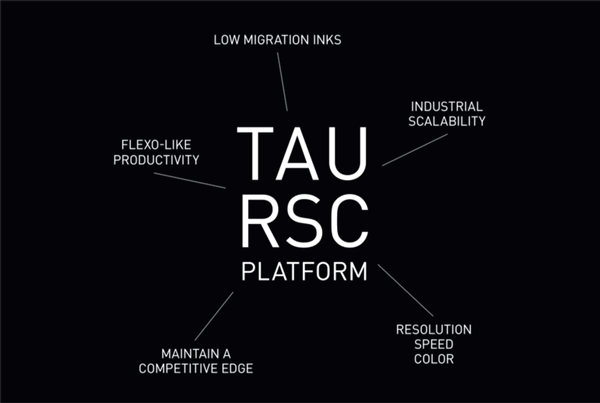
Under the official slogan/claim “WE KEEP YOU PRINTING”, Durst expands its leading-edge RSC platform of UV inkjet label presses with several exciting new innovations.

  • Durst Label Workflow & MIS integration

Starting from dedicated workflow software for Web2Production and Durst’s own PrePress Software “Workflow Label” to customized MIS integration software packages.

  • New Low Migration UV Inks for the Tau RSC series

Additionally, live printing with a newly designed Low Migration UV ink for the RSC platform will be showcased. This new ink targets the food and pharma packaging industries.
The new inks will be available for the Tau RSC E with a printing speed of 52m/min. The inks are available in the colors CMYK O W and are non-retrofittable to existing presses.
The inert system will be a must if a client opts for this ink set. The inks are tested and declared as compliant with industry regulations (Swiss Ordinance, Eupia, Nestle guideline, etc.)


  • New Tau RSCi press introduction

Another highlight at the Durst booth C50 in Hall 9 will be the new & modular Tau RSCi label press with a choice of print width from 330, 420 or 508 mm (13, 16,5 or 20 inches).
The press includes by default the jumbo winders with an integrated roll lift. The print quality is the same outstanding quality as known from the Tau 330 RSC and RSC E. The press uses the Tau RSC UV inks.
Also, the press will reach a higher printing speed of up to 100m/min.  

Also, on the show floor at Label Expo will be Durst’s current Tau 330 RSC and RSC-E presses, which enjoy a fast-growing installed base, already reaching more than 50 units since its delivery start in June 2018. 

AUTOMATED INLINE NOZZLE COMPENSATION – Camera System for increased up-time and availability, retrofittable into existing RSC systems

New features for this well-established Tau RSC press portfolio include a:
“High Opacity White” print mode for an increased “screen-like” opacity and a
“High Speed White” print mode that allows high speed printing at 80 lin. meters of all colors including White. 

Read More

WEB-TO-PRINT FOR LABEL

INDUSTRY 4.0 ENABLES INDIVIDUALIZATION


We believe in people’s desire for individuality

You can offer all imaginable products in your web shop! Our web-to-print software will help you to implement the right sales scenario for your specific clientele and shop type. For example, sell wine labels that customers can design themselves online with images, text and graphics. In addition, you can offer the matching accessories such as a gift bag for wine bottles in your shop. Set up your shop with design templates so the customer only has to customize the text. If your customer wants to reorder any item, it´s an easy process as all job data is stored in his account under “My Orders”.

Read More

PRESS RELEASE – University of Sheffield becomes one of the first UK recipients of new additive manufacturing technology by Desktop Metal


  • The University of Sheffield, working with Tri-Tech 3D, to install latest Desktop Metal Studio Systems
  • New system enables printing of a wider range of components to higher resolution finishes, at reduced costs
  • Desktop Metal Studio System provides on-demand metal 3D printing that can deliver scale and flexibility for diverse engineering needs

JUL 17 2019—BURLINGTON, MA, SHEFFIELD, UK: Two leading manufacturing centres of excellence in the UK have been named as the first to install a transformative additive manufacturing technology, developed by Desktop Metal, a company committed to making metal 3D printing accessible to global manufacturers and engineers. World top 100 academic establishment the University of Sheffield, and global engineering solutions firm Weir Group, are the first UK organisations to implement the Desktop Metal Studio System, working with UK reseller and platinum partner Tri-Tech 3D.

The Studio System is designed to provide an office-friendly metal 3D printing solution that can allow for rapid prototyping at low volume and cost, while providing users with the ability to efficiently produce tooling, jigs and fixtures, features which were previously cost prohibitive. The Studio System has already had a major impact on the additive manufacturing arena, with companies such as Ford, Google ATAP, Goodyear, BMW Group, John Zink Hamworthy Combustion and ProtoLabs, all becoming early adopters of the platform and attracting encouraging interest from fast followers. Based on 2019 worldwide benchmarking data collated by Desktop Metal, many parts produced using the Studio System demonstrated drastic cost reductions – some by as much as 90% relative to machining and selective laser melting (SLM) – as well as speed in fabrication, producing parts in days instead of weeks or months.

The University of Sheffield is working with the Tri-Tech 3D team to install their Desktop Metal Studio System at the Royce Translational Centre. Royce@Sheffield is part of the University of Sheffield’s Department of Materials Science and Engineering and is a major partner of the Henry Royce Institute for Advanced Materials. It comprises the Royce Translational Centre (RTC), and the Royce Discovery Centre, which is currently being built at the University’s city centre campus.

Royce Translational Centre’s Director – Prof Iain Todd, commented:

“We at Royce@Sheffield are very excited to receive our Desktop Metal Studio System. Additive Layer Manufacturing (ALM) is a critical part of the strategy for many high-value manufacturing sectors, as they look to reduce material waste and increase productivity. ALM covers many technologies, and with the Studio System, we are expanding our set of advanced 3D metal printers, which already includes electron and laser beam powder beds, and blown powder methods. Our industry partners range from start-ups to multinational aeronautical manufacturers: for them we represent a valuable missing link between small-scale laboratory metals processing and industrial scale manufacturing. The Desktop Metal Studio System keeps us at the cutting edge of near-net shape manufacturing capabilities in the UK.”

Weir Group Head of Additive Manufacturing – Sozon Tsopanos, commented:

“The additive manufacturing arena is dynamic, growing rapidly as a market, and presents exciting opportunities for innovative companies such as Weir. We are continuing to partner with world-class organisations as we proactively develop our additive manufacturing offering. The addition of this versatile system complements our existing capabilities at Weir Additive Manufacturing Solutions, allowing us to explore, prototype, test and commercialise components and tooling that will deliver significant benefits for our Mining and Oil & Gas customers globally.”

Since its founding in 2015, Desktop Metal has rapidly grown to become a leading systems developer for additive manufacturing technologies, with the Studio System attracting business interest all over the world. Tri-Tech 3D, the authorised UK Desktop Metal reseller, is targeting the rollout to other UK installations in 2019 and beyond.

Colin Cater, sales manager at Tri-Tech 3D commented:

“These first installations lead the way in a new direction for metal 3D printing, making metal parts available and more accessible to a wider range of customers. It complements all those currently using FDM, that require a metal part instead.”

Read More

Durst Analytics


Durst Analytics is our browser based solution to analyze the production data and to monitor the printing systems,
including productivity and print job statistics, daily production figures and critical issue monitoring to prevent down time risks. 

With Durst Analytics+ you can also combine several printers and send the data to your ERP or MIS system.

Read More

Three tales of 3D printers prove how diverse this technology can be.

By Kiersten Wones

We could print you if we wanted to – in one piece,” Matt Cone of Cameron Advertising Displays (Camad) told me as he described his company’s 3D printing capabilities. Camad came to 3D printing as a large-format printer in search of a way to excite both new clients and existing ones. Titanic Design approached the technology from the perspective of a manufacturer. WhiteClouds started as a media company, but suddenly found themselves with clients looking for 3D-printed models. But no matter the journey, what I really wanted to know was: How will this innovation change the way we think about the business of visual communication?

THE ‘WOW’ FACTOR

The folks at Camad (Scarborough, ON, Canada) had been screenprinting for nearly 60 years and large-format digital imaging for nearly 15 when they were approached by Massivit 3D. “When we were being pitched, we probably sat there and scratched the backs of our heads,” said Vice President Dan Deveau, “but once we saw the press, we just knew.”

Cone wasn’t joking when he said they could print me in one piece. The Massivit 1800’s capabilities span up to 57 x 44 x 70 in. “It was a great opportunity to dive into something nobody else was doing,” said Cone. Camad began operating the Massivit in June 2018, but the learning curve was skyscraper steep. From beginning to end, 3D printing is just a different type of journey.

It starts with a sales call, of course, and according to Harky Aulak, account executive, “It’s a completely different sell.” In some cases, you’re calling on new business; in others, you’re having a new conversation with longtime clients. Often, your clients have to pitch the idea to their clients. “What it’s forced my sales guys to do is circle back,” Deveau said. “This is something that has to be nurtured and coddled and miniatures done; there’s a whole new conceptual thing that needs to be understood by all parties.”

Camad 3D-printed this jacket for Roots, a nature-inspired clothing retailer in Canada.

So what makes all the back and forth, the patience and the intensive customer education worth it? “The wow factor,” said Cone. “Everyone that we presented to said, ‘Wow –could see us doing this,’ or ‘I could see us doing that.’”

The wow factor is just what Roots, a national retailer of nature-inspired clothing, was looking for when they said “yes” to a 3D project with Camad. The ask was simple: a 48 x 26 x 48-in. replica of a jacket. The production was straightforward, as well; Camad scanned the “real” jacket with a 3D scanner to create a 3D file. They printed it on the Massivit and then scanned the original jacket again for color. Camad then printed the solid color onto 3M Controltac IJ180Cv3 vinyl via an EFI VUTEk HS100 Pro and wrapped the 3D-printed model.

The jacket-model hung in Roots’ flagship store in Toronto’s Eaton Centre for a few weeks before Aulak received a call: “We sold out of those jackets. Can you take it down and re-wrap it in another color?”

“Well, absolutely,” Aulak said, so they scanned the jacket again, printed it red, and “up it went.”

“We can’t tell you that it’s the 3D jacket that made them sell out,” Aulak said, “but [they] certainly sold.” Roots has 180 locations around Canada – a new challenge for the Camad team.

ADAPTABLE IS EVERYTHING

In 2019, the word “success” is often synonymous with “adaptable.” WhiteClouds (Ogden, UT) is a prime example of adaptability. The business actually originated six years ago as a media company. The plan was to write articles and tutorials about 3D printing. WhiteClouds’ founders had experienced success with other media web properties; 3D printing was the cool new thing, and it seemed like a solid plan.

But before long, folks discovered that WhiteClouds had a few 3D printers behind the scenes – a Maker-Bot Replicator and a 3D Systems Cube – and suddenly engineers and designers were coming to the company for print jobs. “We realized there was more of an opportunity in becoming a print shop versus a media company,” said Cris Fowers, who heads up WhiteClouds’ marketing and business development, and was a part of the company’s founding team.

WhiteClouds settled into a few niche industries: architectural modeling, medical modeling and the world of tradeshows and events. As they produced larger and larger pieces, they realized perhaps 3D printing works best in tandem with other manufacturing processes, and suddenly they had a woodshop complete with laser engravers, CNC machines, foam cutters and more.

The welcome display for this year’s Consumer Electronics Show (CES) was a perfect example of different processes converging. Freeman, the company that manages CES, came to WhiteClouds with 2D artwork and a vision for a welcome display that would capture the spirit of the event and serve as the perfect selfie backdrop for attendees.

WhiteClouds produced this welcome display for the 2019 Consumer Electronics Show.

After formulating a plan that incorporated a 2D backdrop and a 3D display to accommodate the client’s budget, the Freeman and WhiteClouds teams set to work making 3D-ready files. WhiteClouds uses Autodesk Maya for prepress operations. The team elected to 3D print most of the figurines in the display – 11 pieces in total – with the exception of a game controller and the stage.

It was no easy feat; the final display spanned 18 x 6 ft. and required eight weeks of production. WhiteClouds used Creality 3D printers with PLA plastic, and a MultiCam 1000 CNC router. Most pieces were sanded, primed, bonded, sanded again and airbrushed with Createx paint.

As for the decision to print some pieces and cut others out of foam, Fowers said the game controller seemed like a simpler shape that would’ve been more expensive to 3D-print. But after finishing was more tedious than expected, the team wondered if 3D printing would’ve been the more efficient way to go. “The one thing about our industry is pretty much everything we do is a one-off,” Fowers said. “We take our past experience and try to make good decisions.”

ONE PROBLEM AT A TIME

Titanic Design (Mountain View, CA) is a large-scale 3D printing company established in 2016 when its founders saw a need for affordable 3D printing, particularly in the world of engineering. When I asked Tom Price, director of engineering and operations, what kind of clients a company like that serves, he said, “They have a problem that they need solved and they’ve heard 3D printing can help them.”

The problems Titanic has solved range from prototypes for groundbreaking sound-abatement technology to a 7.5-ft.-tall turbo fan engine to be used as a tradeshow prop. “3D printing is just another tool,” Price said. “The challenge is seeing where it works and where it doesn’t work.” He added that 3D printing, especially at this scale, is great for projects that are particularly unique, intricate or difficult to fabricate. Titanic commands a fleet of house-modified 3D Platform printers that can each churn out more than 35 cubic feet.

As for signage, the Titanic team decided to create a 3-ft., in-house display piece that would both test and show off their capabilities. “What would we be without a 3D-printed sign as a large-scale 3D printing company?” Price said.

The two-day job began with Titanic’s engineers adapting the company logo via Solidworks CAD software, but the plan wasn’t as simple as “print a logo and hang it up.” (It never is, is it?) The logo was engineered to print in two shell-like pieces in order to create a stand-out, backlit effect. The back piece is transparent and houses LEDs, and the front piece is teal. The sign looks as if it’s standing off the wall. Titanic used compostable, US-made bioplastic from Push Plastic.

Titanic Design created this in-house piece to display their 3D printing skills.

“I claim signage has some art to it,” Price said. Surrounding the logo element of the sign are functioning gears, which show off 3D printing capabilities, but are also a way for the Titanic team to test how well 3D-printed parts can hold up over time. The sign was hung in late 2018, and so far, so good.

What does 3D printing mean for the business of visual communication? Price reiterated his mantra that 3D printing is just “another tool in the toolbox. We by no means would say you should 3D print everything. You’re always going to have areas [in which] 3D printing can never compete – and I say that as a 3D printer,” he said. Titanic often collaborates with other fabricators, and Price added that traditional methods are still irreplaceable in many ways.

“It comes with an investment in people,” Price continued, pointing out that the engineers and technicians are who make or break this kind of work. And at the end of the day, isn’t that the beauty of it all?

Read More

Valley Container adds state-of-the-art Durst Delta WT 250

Valley Container adds new depth for their packaging solutions with state-of-the-art Durst Delta WT 250

Valley Container, a family owned and operated corrugated sheet plant for specialty display and packaging solutions, continues its growth in the paper packaging space with the addition of the Durst Delta WT 250, a corrugated printer featuring eco-friendly Durst Water Technology. In business since 1969, Valley Container’s commitment to their clients and to sustainability make up the cornerstone to their success in the packaging industry.

“This machine fits well in our workflow as we see it as a complimentary piece for our extensive list of converting machines,” said Robert Niedermeier, General Manager, Valley Container. “The machine is very flexible in just about every way. Specifically, we’re able to slip sample runs in on existing sheets simply through the Durst Workflow software.”

Located in Bridgeport, CT, in their 120,000 square foot facility, Valley Container enjoys an extensive history in the packaging industry, going beyond standard corrugated applications offering: corrugated products, shipping boxes, paperboard products and the design and manufacturing of high-end graphic point of purchase displays. Valley Container’s dedication to providing this extensive range of services through their fully integrated packaging business is designed to meet their clients’ complete packaging and display needs.

Valley Container has partnered with Durst for their printing equipment needs, with the recent purchase and installation of the digital Durst Delta WT 250. The Delta WT 250 is a leading corrugated and display packaging print solution featuring eco-friendly Durst Water Technology. It is suited for a range of applications and offers the ability to produce high quality output in standard or custom sizes from a batch size of one.

“Valley’s digital choice began about 10 years ago, as we began investigating this new technology that we knew would be disruptive in our packaging industry,” said Niedermeier. “The first step was to vet the technology and really learn all about what it had to offer.

Once Valley Container had an idea of the digital corrugated printer landscape, they needed to decide on single-pass or multi-pass technology and with their unique footprint in the display world, multi-pass technology best fit their needs. In addition, to maintain their industry leading commitment to sustainability, Valley Container also researched an innovative solution for UV or water technology, while still being able to maintain the quality print they are known for.

“That was a no brainer for me, as I felt that Durst Water Technology inkset gave a better print quality without any of the inherent risks,” said Niedermeier. “Durst was by far the only water technology machinery company who had the best reputation in the market. The Delta WT 250 gives us the ability to provide a sustainable product with its water technology inkset, all the while, showcasing our creative capabilities to their highest levels.”

Durst is a family company with an 80-year history, where the values are focused on innovation, customer orientation, sustainability and quality. High productivity, printing reliability and flexibility are the unique features of Durst inkjet technology. As a company that believes in developing long-term relationships with its customers, Durst uses customer feedback and experiences to develop innovative solutions designed to improve production and workflow.

“Durst is a first-class company in every way. From the beginning of the sales process to the delivery, installation and start up,” said Niedermeier. “As with every new machine installation, there are learning curves, but Durst never left. The Durst technicians were there to remedy any issue, where now it simply just runs smooth as silk.”

The Delta WT 250 is an ideal solution for those looking to increase their capabilities with seamless integration to their existing workflow. It prints with a maximum 6 colors up to 3,700 sq ft/h and the multi-Pass printing system can be adapted to suit specific customer requirements. The different peripheral components offer an easy manual solution right through to a fully automated feed solution. The Delta WT 250 represents a new generation of printer incorporating Durst Water Technology. The system prints from flexo quality up to superb litho quality with odorless ink that are completely free of hazardous labeling and comply with the strictest health and safety regulations.

“There were two major offerings that made the Durst shine brighter. The first was the fact that it had an automated feeding solution making the machine fully efficient on the front end, the most important part of any efficiency study,” said Niedermeier. “The second offering was the ability for the machine to run two sheets side by side…. having the ability to run jobs side by side, we double our output of sheets and really get our productivity ramped up each job.”

“Since the launch of the Delta WT 250, the overwhelming interest in the Durst Water Technology reflects directly on our focus to support our customers, by furnishing innovative printing solutions for increased value,” said Tim Saur, Managing Director, Durst North America. “We’re in for the long term to develop new partnerships and help companies such as Valley Container. It’s not just about the outstanding systems we provide, but an all-round customer service offering that is second to none.”

The Durst Delta WT 250 has evolved into an industry leading corrugated packaging and display printing solution. Durst’s commitment to the corrugated industry and customers’ needs has led to continued advancement in the digital print space. Working together, customer partnerships such as with Valley Container inspire and encourage new innovations and solutions.

“We are not afraid to take a risk with new ideas and technology to push the envelope of what we have to offer,” states Robert Niedermeier, General Manager, Valley Container Inc. “The Durst is a perfect example of this.”

Read More

Durst at forefront of evolution for digital production in textile printing

Brixen, Italy – 09.07.2019 –

Durst, manufacturer of advanced digital printing and production technologies and at the forefront of the web-to-print revolution in fabrics, has affirmed its technological commitment to the dynamic textile industry with prestigious deals in key growth sectors across the world.

Leading the web-to-print charge and located at the crossroads of digital textiles and e-commerce is Spoonflower, the US online community that has built its bedding and table home décor business around Durst’s pigment technology on the Alpha platforms. It has chosen to invest in two more Durst Alpha 330 Series 5 with pigment – one for North Carolina, USA, and the other in Berlin, Germany – to support its adoption of eco-friendly digital textile printing technology.

Spoonflower allows individuals to design, print and sell their own custom-designed fabric, wallpaper, and home decor products. The Spoonflower marketplace hosts the largest collection of independent fabric designers in the world, with over 1 million designs available to suit every taste and style. With environmentally sustainable on-demand manufacturing, no minimum order requirements, and zero finished goods inventory, Spoonflower exemplifies an integrated “pixel to output” approach.

Gart Davis, who co-founded Spoonflower in 2008, said: “Spoonflower is not just a service for custom fabric printing, we are a community that prizes individuality, self-expression, and a human connection between designers and those who want to bring design into their homes.  Pigment printing is a future technology that we use today thanks to the hard work and strong partnership with Durst. Our collaboration on home decor has been successful; the Alpha produce beautiful fabric with a precise, fine print, a broad gamut, and strong fastness properties, which is why we have invested in two more pigment Alpha 330s.“

Christoph Gamper, Durst CEO and Co-Owner, said: “As a pioneer in the web-to-print for fabrics, sustainability and pigment sectors our technology platforms represent the “new” textile. It’s not only speed but clever solutions too. The world needs more companies that question the status quo. We’re at the forefront of the evolution that will sweep across the textile industry. This is just the beginning.”

The Alpha 330 Series 5 is the fifth generation of Durst’s Alpha printing systems. It features newly-developed software to meet the increased demands of textile digital printing as well as improvements in material handling, efficiency and material diversity. The technology platform offers a sustainable, flexible and scalable solution for every application and enables waterless one-step production with Durst Advanced Digital Pigment ink. SuperMultipass™ provides 30% better performance than comparable systems by integrating new technologies in the printheads, inks and drying units. The Alpha Series 5 can also have a patented SwiftJet Pretreatment System positioned upstream of the Alpha printer – valuable for short-run and fast-turnaround jobs.

A family-owned company with a history stretching back more than 80 years, Durst Group’s values are focused on innovation, customer orientation, sustainability and quality. The US division of Durst, which is based in Rochester, is a full-service subsidiary and highly integrated service provider.

Backed by consultancy and seamless integration provided through Durst Professional Services, all systems can be equipped with the new Durst Workflow Print, monitoring tool Durst Analytics and Durst Smart Sh

Read More

DURST RHO 512R LED: εντυπωσιάζει με την ποιοτητα και την ταχυτητα εκτυπωσης

Η Hruby, μια επιχείρηση που ιδρύθηκε στο Kreuzberg του Βερολίνου το 1919, γιόρτασε την 100η επέτειό της τον Απρίλιο του 2019 και με τη σημερινή της ονομασία Hruby Werbetechnik GmbH είναι μια από τις πιο ευέλικτες επιχειρήσεις στο Βερολίνο, απασχολώντας 25 άτομα. Τα πλεονεκτήματα της ομάδας, η οποία διευθύνεται από τον διευθύνοντα σύμβουλο τρίτης γενιάς Fritz Naumann, περιλαμβάνουν εξατομικευμένες συμβουλές, ευελιξία και εφαρμογές με δύσκολα προϊόντα. Ο Fritz Naumann ξεκίνησε στη Hruby ως επαγγελματίας εκπαιδευόμενος, μαθαίνοντας την επιχείρηση από το μηδέν και αναλαμβάνοντας την ευθύνη για την εταιρεία το 2010.

Το 2019, η Hruby Werbetechnik GmbH επέκτεινε τις δραστηριότητές της προσθέτοντας ένα LED Durst Rho 512R σε υποκατάστημά της στο Βερολίνο και εντυπωσιάστηκε από την ποιότητα και την ταχύτητα εκτύπωσης. Στόχος είναι η κάλυψη νέων προϊόντων και μεγαλύτερων σχημάτων καθώς και της φιλοσοφίας της εταιρείας για υψηλή ικανοποίηση των πελατών της και ποικιλομορφία της παραγωγής.

Read More