Articles posted by Nikos Karagiannis
- Home
- Articles posted by Nikos Karagiannis
Durst converts its demo center in Brixen to protective mask production
Brixen, Italy – April 15, 2020 – Durst, manufacturer of advanced digital printing and production technologies, is responding to the lack of suitable protective masks for the industrial work environment by converting the demo center at its Brixen headquarters, South Tyrol, Italy.
On Monday, April 6, Durst was able to return to partial operation in its plants in Brixen and Lienz, East Tyrol, Austria, as the printing systems for the label and packaging industry were classified as system-relevant and customer productivity had to be guaranteed. Now Durst is going one step further and will convert the textile printing and processing systems, which are located in the demo center for customer demonstrations, to the production of protective masks. These are protective masks with an integrated filter function. Durst has many years of experience with filter systems, as these take on a kind of “cleaning function” in the printing press to filter out microparticles in the ink supply systems so that the print heads do not become clogged and are always ready for use.
With the extensive know-how of Durst Development and the Durst Laboratories, a certified filter membrane has now been identified, which is suitable for use in protective masks due to its high air permeability. The membrane with hydrophobic properties and microporous structure blocks particles with a filtration efficiency of up to 95% and is particularly suitable for industrial work environments. The protective masks are constructed in three layers, the polyester fleece textile materials are washable, the filter membrane can be reused after disinfection by spraying with alcohol and can also be easily replaced if necessary. The N95 classification of the filter membrane is available and Durst will also have the protective masks certified as a finished product.
Durst will manufacture the protective masks for its own group and sister company Alupress and make the production capacity and know-how available to other companies. Durst is currently investigating possible sales locations and structures for end customers in order to make the protective masks available to a broad population. In order to be able to meet the expected high demand promptly, Durst is also looking for other sewing companies to speed up the assembly work. Production is planned to start in mid-April and Durst is open to possible ideas to continue the initiative. For example, Durst will use an online editor to personalize the protective masks with graphics, text or a logo.
“After we were able to go back into partial operation at the beginning of April, we wanted to make our know-how and resources available to make our contribution to the protection of people,” said Christoph Gamper, CEO and co-owner of the Durst Group. “We have created the technical prerequisites. Now it is a question of starting production and gradually expanding our initiative to provide protective masks for as many people as possible in our region. With the individualization of the protective masks, we can even make it easier for our children to deal with the situation and we will also set up a creative competition for this.”
In addition to the production of protective masks on the demo printing machines, Durst has also switched parts of its ink production to its own hand disinfectant. The Durst Laboratory has formulated a virucidal and antibacterial solution based on ethanol for this, which can be used anywhere in handy 0.5 liter dispensers. Upon request, Durst also takes over the production and personalization of the hygiene article for third-party companies.
For further information on the Durst initiative visit:
WHAT MAKES THE DURST PROTECTIVE MASKS SPECIAL
- High quality workmanship „Made in South Tyrol“ by Durst and protected sewing workshops
- Special filter element, highly effective (type N95) exchangeable and reusable
- Despite high filter efficiency, good breathability
- Customizable with logo, text and designs
- Textile materials are washable and OEKO-TEXⓇ 100 certified
The protective masks are constructed in 3 layers, the polyester fleece textile materials are comfortable to wear and washable, the filter membrane can be reused after disinfection by spraying with alcohol and can also be easily replaced if necessary.
Spoonflower, Durham, North Carolina, USA
After extensive research into best-in-class technologies, Spoonflower invested in a Durst Alpha with Dual-Roll option digital production printer. Running a strong e-commerce-based business, Spoonflower places high value on sustainability, as well as demands for speed, high quality and fast turnaround times.
Medtech testimonial about using XJet system to prevent breast cancer
Guided MRI for cancer treatment
Marvel Medtech has developed an interactive MRI system called Solada. It is a robotic system which allows intervention inside the MRI imaging bore. Researchers have classified these kinds of robots as surgical computer-aided design and computer-aided manufacturing (CAD/CAM) robots, distinct from ‘surgical assistant robots’.
A CAD/CAM robot is a surgical guidance system which requires human intervention. For example, in case of a biopsy, despite the guidance of a robot the biopsy needle will still have to be probed by a physician.
Marvel Medtech calls Solada an interactive Magnetic Resonance Imaging Guided Intervention (iMR-IGI). The device enables real-time monitoring and guidance of probes for surgical procedures inside the MRI scanner.
For now, Marvel Medtech is focused on developing Solada for breast biopsy only. So far, the medical company has raised $2,500,000 which includes $2 million in grants from the National Cancer Institute (NCI) and National Institutes of Health (NIH).
3D printed cryotherapy probe
Marvel Medtech acquired the Carmel 1400 machine because it is capable of 3D printing precise and complex ceramic objects with soluble supports. The Carmel 1400 machine will be used to 3D print a ceramic cryotherapy probe for the Solada robotic system. The probe will help destroy tumorous breast cancer cells.
Ray Harter, President of Marvel Medtech, explained, “The tools used inside an MRI scanner must be compatible with strict safety guidelines, and crucially, not disrupt image quality. Because they are one of the most electrically insulating materials, ceramics are an ideal material to achieve this.”
Harter continued, “However, we were unable to find a ceramic-based 3D printer able to accurately and cost effectively produce our ceramic probe. This is why we are adopting XJet’s Carmel 1400 solution.”e.”
Fight against cancer
3D printing in the medical field is having a significant impact, especially in the fight against cancer. Treatments that were limited before due to complex tools not being available are now more effective. Such examples include 3D printed bolus for administering medicine, full-body phantom and presurgical models.
Now, Xjet’s Carmel 3D printer will make another marvel in medicine achievable which once was perhaps improbable, if not impossible.
Danai said, “This application is a great example of how our unique ceramic 3D printing technology can enable manufacturers to overcome the limitations of traditional ceramic production. Indeed, we believe that XJet NPJ opens the door for the invention and production of many new products and tools to answer some of mankind’s biggest challenges, and we’re excited to see how it will impact our lives in the future.”
Metal 3D Printing Services for COVID-19 Supplies
The global impact of this novel coronavirus has had a tremendous impact on the medical community and has overwhelmed their already exhausted supply chain. We want to do all that we can to support these professionals in their efforts.
Desktop Metal is offering medical equipment manufacturers and those making critical medical parts, access to our technology and engineering resources in order to provide free 3D printing services.
Coronavirus Personal Protective Equipment (PPE) 3D Printed with Massivit 3D
Massivit 3D PPE Face Shields Now Available from 3D Printing Services Worldwide
Massivit 3D’s global network of customers are available to produce Personal Protective Equipment Face Shields. The STL file and instructions can be downloaded here. [Original design of face shield by Twan Kerckhofs, ART Nzo.]
What’s the Coronavirus ? How can Personal Protective Equipment Help?
Coronaviruses are a large family of viruses, with the most recently discovered causing the COVID-19 coronavirus disease. The COVID-19 is spread from person to person through small droplets from the nose or mouth due to coughing or exhaling.
The sweeping COVID-19 outbreak has led to a major shortage in basic Personal Protective Equipment (PPE) for hospitals and medical centers. Massivit 3D, in an effort to contribute to prevention and control of this pandemic, has devised a PPE Face Shield. Using the high speed of Massivit 3D printers, 200 face shields can be produced per day. The Massivit 3D PPE Face Shields are available from Massivit 3D customers and distributors worldwide. To find your local Massivit 3D printing service, email us here.
CAPABILITY TO PRODUCE 200 FACE SHIELDS PER DAY
For in depth Coronavirus information and global updates, please refer to the official World Health Organization (WHO) website.
Massivit 3D customers and partners are requested to inform us if they decide to 3D print the new PPE Face Shields and update our company with the names of hospitals receiving the face shields as well as providing photos of the face shields produced.
Like to Contribute Your Own Technological Innovations to Mitigate the Coronavirus?
If you’ve developed your own idea or technological innovation to help prevent the current spread of the COVID-19 Coronavirus, and you’d like to approach us to be involved, please contact us and we’d be happy to discuss.
EnvisionTEC Partners With Healthcare Community to Battle Global Pandemic
Dearborn, Michigan, March 29, 2020 – The 3D printing industry has been working closely with the medical community for many years. From the dental and hearing aid sectors, both of whom have adopted 3D printing as a primary method of production in a myriad of applications, to the medical and biomedical fields, who have integrated 3D printing into scientific research and the development of new medical devices, this partnership has yielded thousands of invaluable improvements into the daily lives of people the world over. EnvisionTEC has been at the forefront of these cooperative efforts since 2002, paving the way for new solutions that could only be made possible via 3D printing.
The 2020 COVID-19 pandemic has proven to be another opportunity for 3D printing to assist in finding new, innovative ways for healthcare professionals to provide assistance. A shortage of the necessary diagnostic and treatment supplies has been discovered, and while many businesses have jumped in to help, it is 3D printing that may be able to provide real answers for how to combat the supply chain crisis.
Working hand-in-hand with healthcare leaders, EnvisionTEC founder and CEO Al Siblani and his team of engineering and applications specialists, with the help of some dedicated customers have identified several areas where their specific strengths in biocompatible materials and fast, precise 3D printing equipment can help to provide replenishment of stocks as well as new, alternative solutions.
he main focus of EnvisionTEC’s efforts thus far has been on the lack of ventilators for increased demand, personal protection equipment (PPE’s), and nasopharyngeal (NP) swabs for specimen collection for testing.
Individual ICU ventilators are critical in the treatment of patients in severe respiratory failure, a symptom of severe cases of COVID-19. It has been determined that the demand for these ventilators will far exceed the current stock on hand. Manufacturing giants such as Ford and GM have been tapped to assist in the production of these machines, but even with the increased manufacturing capabilities, the process to get these machines ordered and in the hands of the medical professionals who need them could cause delays. Al Siblani has been working with local hospitals in the Metro Detroit area to provide a functional ventilation splitter that could be 3D printed in a Class 1 material such as EnvisionTEC’s E-Guide. EnvisionTEC is working with the FDA to authorize the use of 3D printed splitters as an emergency solution to allow for multiple patients to receive oxygen from the same ventilator by adjusting the pressure controls on the ventilators to allow for dual-patient use. By using 3D printing for these accessories, production could be scaled up in locations close to where the need is greatest, allowing for fast reaction to the growing problem and more than double the capacity of current ventilator stock.
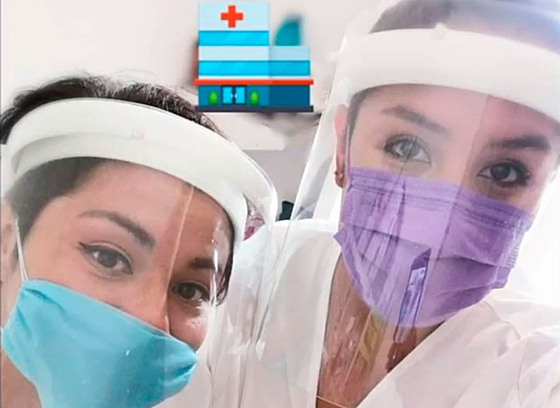
In order to effectively treat the growing number of COVID-19 patients, healthcare professionals and many other essential workers rely heavily on PPE’s in order to safely maintain their own health. Many mask designs are meant to be single-use, and with the general public adding to the demand for these items, they are becoming increasingly hard to come by. Again, 3D printing is an ideal solution, allowing for portions of face shields to be printed and sterilized. EnvisionTEC has a number of large 3D printers that can quickly and efficiently print these parts in bulk, and many of their customers have been able to answer the call for local needs.
Perhaps the biggest immediate need in the fight against COVID-19 is simply identifying those who have been infected as early as possible. Testing kit availability has been vastly inadequate, and the medical community has been working tirelessly with the 3D printing community to find a solution to mass-producing the nasopharyngeal collection swabs to alleviate the shortage quickly. EnvisionTEC has been working closely with the Harvard Microbiology Lab within a larger group dedicated to connecting academia with the manufacturing industry to combat this shortage.
.
To this end, EnvisionTEC engineers have designed a collection tip for a flexible nasal swab. Brian Nilson, of Nilson Laboratories, 3D printed the final design for testing. He was able to print 400 of the swabs in Class 1 approved material E-Guide on his Envision One cDLM in two hours. The testing process is comprised of a ten stage mechanical testing, a two part absorption test, a biological/chemical testing procedure to ensure the swab absorbs viral RNA particles and does not interfere with PCA/reagents, and a sample collection testing procedure. To pass, a sample needed to use a material that is approved as chemically safe, would bend 180 degrees without breaking, and the design needed to be able to safely collect enough virus particles from the nasal passage to effectively test.
E-Guide has passed some of these tests and is awaiting final IRB testing and approval. Under FDA regulations, an IRB group that has been formally designated to review and monitor biomedical research involving human subjects has the authority to determine that E-Guide is suitable for the mass production of the NP swabs for COVID-19 testing. EnvisionTEC has long been committed to providing solutions to their customers and is now preparing to take on the call to action of helping to equip medical professionals with the tools needed to help combat this global pandemic. With a vast network of thousands of customers eager to help, EnvisionTEC is proud to offer the capability of producing hundreds of thousands of the swab per day
About EnvisionTEC
EnvisionTEC is a leading global provider of professional-grade 3D printing solutions. Founded in 2002 with its pioneering commercial DLP printing technology, EnvisionTEC now sells more than 40 printer configurations based on six distinct technologies that build objects from digital design files. The company’s premium 3D printers serve a variety of medical, professional and industrial markets, and are valued for precision, surface quality, functionality and speed. For more information, please visit https:///envisiontec.com.
Label Products finds ‘complete package’ with Durst and Wifac after extensive market research
Brixen, Italy / Waregem, Belgium – 02.04.2020 – After a comprehensive investigation of the label market, Label Products has invested in a Tau 330 RSC E inkjet press from Durst, manufacturer of advanced digital printing and production technologies, and Wifac to continue organic expansion. “With our spread of markets and a strong commercial presence in Belgium, the Netherlands and France we are going to benefit from that growth,” says Matthias Dhondt, Production Manager at the company based in Waregem, Belgium. “Our investment in the Tau 330 RSC E plays a key role.”
The deal with Durst and Wifac, its distribution and service partner across BENELUX, is a complete package, said Matthias Dhondt who, together with Stephan and Maarten Dhondt, forms the future of Label Products. “The Durst Tau 330 RSC E immediately caught our attention, but we needed to undertake a thorough investigation of the market,” he said. “We visited companies in Switzerland, Austria, Poland, Italy and other countries. We analyzed the operation of the various heads, the quality of the work, the speed of the machines, the price of ink and substrates.
“At the end we opted for the Tau 330 RSC E because of its impressive print quality and productivity and have never looked back. It’s a complete package. Ultimately, it’s about the total cost of ownership. At first, we wondered whether we would have enough volume on the press, but that hasn’t been a problem. More and more variable and tailor-made labels are being provided for various customers. So, a digital press is better than flexo printing.”
Another important factor for choosing Durst was the support and service provided through Wifac. “You can’t afford downtime and we have two service technicians on standby,” said Mr. Dhondt. But since the installation in the middle of 2019, not once have we needed to use them. The relatively simple operation of the press is another positive element for the business, particularly when skilled operators are hard to find due to skill shortages. We are a real family business with an open mind to helping our employees. In our finishing department, we were able to provide one employee with the chance to work as an operator on the Durst Tau 330 RSC E. She seized that opportunity with both hands.”
Continuing controlled growth is the aim for Label Products this year, as well as certifying itself for the British Retail Consortium. The BRC’s Standard for Food covers hygiene and safety requirements for food processing companies supplying the retail sector. From special clothing and hygiene regulations to visitor registration, the BRC works well throughout the whole company. “We have a focus on food sectors, but don’t lose sight of other markets,” Mr. Dhondt. “The strength of BRC is that this approach takes Label Products to a much higher level of quality.”
The family-owned company employing 36 people, which was founded by Pieter and Marc Dhondt in 1986, produces labels and tags on four flexo and digital production machines. Originally started as an offset print business, it has expanded into new areas, including label markets.
Helmuth Munter, Durst’s Segment Manager, Labels and Package Printing, said: “Our Tau RSC platform is setting new benchmarks in growing numbers of markets for companies such as Label Products. We offer a total package to all our customers in terms of high quality, the best possible service and resulting production reliability. Across BENELUX, this is with our partner Wifac. It’s a win-win combination.”
Comprehensive, individual customer solutions thanks to Durst’s complete Smart Shop solution
“Since the installation of the complete Durst Smart Shop solution we can offer our customers even more creativity and flexibility in product design. The setup of the frontend was very easy even without any previous knowledge – due to the many pre-installed tools. The support from Durst was fantastic, and the software team is always available to help us with any questions we may have.”
Matthias Banike, co-owner of Werbescheibe.de, Hwang & Banike GmbH
The innovative company Werbescheibe.de, based in Dortmund, has been supplying vehicle advertising systems and large-format digital prints for small and medium-sized companies, such as driving schools, craftsmen, delivery services, insurance companies and dental practices for over 15 years. Matthias Banike, founder of Werbescheibe.de, had worked with a self-developed webshop for a long time before opting for Smart Editor software in 2015.
For Mr. Banike, the flexibility and easy handling compared to other solutions was the decisive factor: “The Smart Editor convinced us from the beginning, because it is individually configurable and extremely flexible. In addition, print products with very different shapes and formats can be set up. The choice of tools for the design is very large and can be set up according to customer group and needs.“
In order to make the exchange of data even smoother and thus give customers even more freedom in product design and ordering, Mr Banike decided to invest in Durst’s complete Smart Shop solution in 2019.
“It was important to us that we could configure the shop ourselves,” says Mr. Banike. “We have many different tools that we can offer customers, but not every function makes sense for all products. For example, we offer different layout templates for specific customer groups, where just the color and text can be changed in a very user-friendly way. The design process, especially for simpler products such as magnetic foils, is therefore extremely uncomplicated and fast. If customers do not want to use the templates, they can also design their own, as the solution offers great flexibility.
Whether vehicle advertising, advertising panels, floor films, wall films, window films, perforated films, PVC films, banners, posters or beach flags – all print media can be designed directly online, checked in the 3D preview and then ordered. Simply place a logo or image on the drawing surface, enter the appropriate text and the print products are delivered directly to your home or company.
“Many customers are particularly enthusiastic about the ‘product preview in the application’,” explains Mr Banike. “For example, roll-up products can be placed in a virtual room so customers can see exactly what the product will look like in a salesroom. This gives customers a much better idea of how certain products will look in a natural environment.” Many customers also like the fact that the customer templates are saved and can be retrieved later.
The digitally created print products are designed in such a way that all films and advertising systems can be assembled by the customer himself with the help of assembly instructions. It is also possible to download print templates and create complete designs via the marketing department or a graphic designer and upload the file in the order process.
“Despite our wide range of products and the provision of layout templates, we were able to complete the basic setup of the shop within a few weeks,” said Mr Banike. “The setup was easy and didn’t require much previous knowledge, as the functions in the back-end of the Smart Shop solution, such as the Page Builder plugin, contribute to an easy website design. Durst has proven to be a professional partner every step of the way. The investment has had a very positive impact on our business and we’ve gained many new customers.”
Wagner Prestige Labels reduces waste and ramps up capacity with Durst Tau 330 RSC E investment
Durst, manufacturer of advanced digital printing and production technologies, has solved waste and digital capacity issues for family business Wagner Prestige Labels with the installation of a Tau 330 RSC E inkjet label production press.
Wagner’s choice of Durst’s RSC technology was driven by speed, quality and environmental considerations. “We decided to ramp up digital color capacity to the highest we could, and the Durst Tau 330 RSC E came up trumps,” said John Galea, Managing Director of Wagner Prestige Labels, of Wetherill Park, Sydney, Australia. “In only six months it has really proved itself, to the point that digital is now between 30 and 35% of our business. The quality of the labels is right up there with flexo and letterpress.
“Another important benefit is that waste is greatly reduced, with the threaded meterage on the Durst Tau 330 RSC E even being able to be drawn back and printed. Waste is a big issue for label printers, especially with multiple versions, so anything we can do to reduce it is good for the environment.”
The Durst Tau 330 RSC E is the beating heart of Wagner Prestige Labels’ one-stop solutions business, which has diversified into new areas and is also part of the JV Group that brings together label, printing and embroidery companies to provide customers with a complete promotional service. Web inspection devices and processes including flexo, letterpress, screen, thermal paper, hot and cold foiling, die-cutting, laminating and, elsewhere within JV Group, dye-sublimation and embroidery for textiles plus general commercial printing.
“We do everything in-house, and, if a customer wants a fully-embellished label with embossing, foiling, spot varnishing, fancy die-cutting, we have the equipment to do it,” said Mr. Galea. “You have to keep up with changes – change enables growth and diversity, but you also have to make sure the right job goes on the right machine. Before the investment in Durst’s RSC technology we were falling short on digital capacity. Our customers – trade, print brokers and end-user – are tending to order shorter runs, more frequently, so we carefully researched all the available options. The Durst has proved to be the ideal choice.”
Helmuth Munter, Durst’s Segment Manager, Labels and Package Printing, said: “The Durst Tau 330 RSC E was originally launched to bring affordable digital production to increasing numbers of small converters and sets the base for the future of industrial digital inkjet printing in the label industry. In line with our ‘We Keep You Printing’ strategy, it’s also proving to be a real attractive prospect for forward-thinking companies like Wagner Prestige Labels that need variable, versatile, adjustable and configurable digital printing systems to expand their business reach while enjoying other benefits such as waste reduction and a significant jump in production capacity.”