Maroussa Farewell Announcement


It is with unbearable grief and unspeakable pain that the LINOGROUP family bids farewell to our creator, friend and colleague Maroussa Konstantinidou.

Our Maroussa, who will no longer be with us, has always been an uncompromising and genuine supporter and support for all of us, both in joys and sorrows.
She was distinguished, apart from her kindness, her positive thinking and her humor, for her effectiveness in whatever she was involved in, giving us many times in her own inimitable and direct way solutions that the rest of us find difficult to find.
She fought bravely with cancer, bravely and with incredible dignity facing the unfair blow of fate as a fighter.

It is hard to fill the void that our Maroussa leaves in all of us.

For us she is a part of our lives.
Goodbye to our Maroussa.
We bid you a crushing farewell.
We will always remember you.

Your colleagues at LINOGROUP


Read More
w Durst dye-sublimation printer P5 TEX iSUB

„Thanks to the inline fixation iSUB, we have a great saving in time”

Success Stories
The Dutch customer API-4-BRANDS is the first customer in Europe, who invested in the new Durst dye-sublimation printer P5 TEX iSUB. Raymond De Wild, owner API-4-BRANDS, highlights in the interview the smooth installation process with the machine. Only a few days after the installation production jobs run already without problems. Thanks to the integrated inline fixation iSUB, the P5 TEX iSUB gives a great saving in time. A job can now be completed in one hour (compared to 4 hours when using an external heat press) and delivered very quickly.

Read More

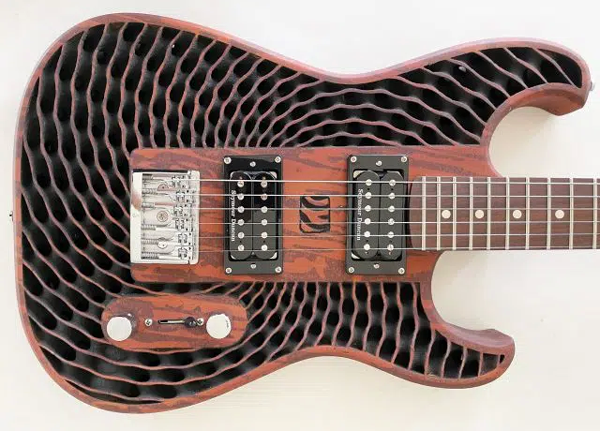
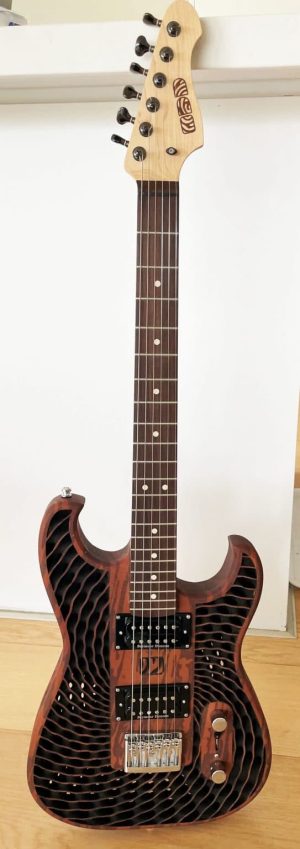
This amazing guitar was 3D printed in real wood

This article comes from 3D Printind Media Network

We’ve seen guitars 3D printed in plastics and then 3D printed in metal (many of these were done by Olaf Diegel, Professor of Additive Manufacturing at the University of Auckland). But we had yet to see a working guitar 3D printed in real wood. For that, we needed Forust technology.

The company was founded on the experience with binder jetting of wood powder conducted by Emerging Objects over the years. Its technology has been combined with the creativity of Desktop Metal’s marketing team (led by Ilya Myrman, also a guitar enthusiast) after acquiring Forust in the recent shopping spree, and the DfAM capabilities of Professor Diegel.

The result looks stunning and, according to Prof. Diegel, who also plays the guitar very well, it sounds great. The Forust process leverages a binder jetting additive manufacturing process with wood sawdust and bio-epoxy resin as a binder. If optimized for high productivity, it could represent a more sustainable future for the manufacture of high-end wooden products.

The design was done using a combination of Solidworks and nTopology. According to Prof. Diegel, it contains a diamond TPMS lattice structure (an improved version of a gyroid). The guitar is fitted with Seymour Duncan hot-rodded humbuckers, Schaller bridge and switch, Gotoh tuners, and a Warmoth maple/rosewood neck.

“The on-demand 3D printing of wood using waste natural materials is a gamechanger,” commented William McDonough, Architect, Author of Cradle to Cradle [….] We have only begun to explore its beneficial potentials, but it is clear they are immense.”

The best part of this project is that the material cost is almost null. For now, there are costs associated with the machines and software used, and especially the time and skills required to design it. As these become more widely established, though, the cost of digital wooden products could be drastically reduced. The future of 3D printed wood looks and sounds great.

3D_Printed_Wooden_Guitar_Forust_4034-543x1536

Please read the original article by Davide Sher at 3D Printing Media Network by clicking below

Read More

Durst Tau 330 RSC-E για την DIGI PRINT AL στα Τιρανα, Αλβανια

Η DIGI PRINT – AL SH.P.K. ιδρύθηκε το 2007, με έδρα τα ΤΙΡΑΝΑ της Αλβανίας και είναι ένας κορυφαίος πάροχος υπηρεσιών εκτύπωσης.
Το όραμά τους είναι να προσφέρουν στους πελάτες τους προϊόντα στην καλύτερη ποιότητα, στην ώρα τους, στην καλύτερη τιμή και καινοτομία.
Η DIGI PRINT AL προσφέρει ένα τεράστιο χαρτοφυλάκιο εφαρμογών, όπως banners, εκτύπωση υφασμάτων και χαρτιών, αυτοκόλλητες και φωτιζόμενες επιγραφές, πίνακες και πάνελ, διακόσμηση βιτρινών, εκτυπώσεις εσωτερικού χώρου, branding αυτοκινήτων και διακόσμηση εκδηλώσεων.

Πρόσφατα η εταιρεία αποφάσισε να προσθέσει μια νέα τεχνολογία για να διευρύνει τις προσφορές προς τους πελάτες της στο τμήμα της αγοράς της ετικέτας και της συσκευασίας. Μετά από σύγκριση των υφιστάμενων τεχνολογιών αποφάσισαν να επενδύσουν στo ψηφιακό πιεστήριο παραγωγής ετικετών inkjet Durst Tau 330 RSC E.

Ο κ. Juland Mustafaj δήλωσε σχετικά με την απόφαση αυτή: “Γνωρίζουμε την Durst εδώ και μερικά χρόνια, καθώς διαθέτουμε ήδη Durst UV inkjet εκτυπωτές (Durst P5 350 Hybrid – επίπεδος & ρολο-σε-ρολό και Durst Rho 500R ρολό-σε-ρολό) για εκτυπώσεις ευρείας μορφής. Η αγορά ετικετών και συσκευασιών αναπτύσσεται στην Αλβανία και την Ευρώπη και ήδη είχαμε αιτήματα από τους πελάτες μας. Η έρευνα που κάναμε πριν αποφασίσουμε την επένδυση έδειξε ότι το ψηφιακό πιεστήριο της Durst έχει όλα όσα αναζητούσαμε: ποιότητα, ταχύτητα, ευελιξία και χαμηλό κόστος παραγωγής.
Το Tau 330 RSC E προσφέρει εξαιρετική ποιότητα εκτύπωσης σε μια τεράστια ποικιλία υλικών εκτύπωσης και θα εισέλθουμε σε αυτή τη νέα για εμάς αγορά σίγουρα με το κατάλληλο πιεστήριο ετικετών”.


Το πιεστήριο έχει πλάτος εκτύπωσης 330 χιλιοστά, εξοπλισμένο με 7 χρώματα, με τις επιλογές πορτοκαλί, μωβ και λευκού, σε λειτουργία πλήρους ταχύτητας.
Με την εγγενή του ανάλυση 1200 x 1200 dpi σε συνδυασμό με το μικρότερο μέγεθος σταγόνας των 2pl και με τα πρόσφατα ανεπτυγμένα, υψηλής περιεκτικότητας σε χρωστικές ουσίες μελάνια Durst Tau RSC, το πιεστήριο παράγει εξαιρετική ποιότητα εκτύπωσης.
Τα πιεστήρια Durst RSC είναι εξοπλισμένα με το προηγμένο λογισμικό Durst Workflow Label και το λογισμικό Εκτύπωσης Μεταβλητών Δεδομένων, ώστε οι πελάτες να μπορούν να προετοιμάζουν γρήγορα τις εργασίες εκτύπωσης για την απαιτητική αγορά ετικετών.

Μια νέα λειτουργία Ink Save Mode επιτρέπει στους χρήστες της πλατφόρμας Tau RSC να μειώσουν το κόστος μελανιού κατά μέσο όρο 12%. Το λογισμικό Durst Analytics αναφέρει λεπτομερώς τα δεδομένα παραγωγής για την απόδοση της λειτουργίας.
Τα πιεστήρια RSC περιλαμβάνουν μια νέα λειτουργία αυτόματης συντήρησης για την αποφυγή διακοπών λειτουργίας και τη μείωση του κόστους σέρβις. Ο αυτόματος καθαρισμός των κεφαλών εκτύπωσης πραγματοποιείται χωρίς επαφή από την ενσωματωμένη μονάδα συντήρησης, για καλύτερη και σταθερή ποιότητα εκτύπωσης.
Η παραγωγική ικανότητα των 1.020 τετραγωνικών μέτρων/ώρα είναι εφικτή με ταχύτητα εκτύπωσης 52 μέτρων/λεπτό με όλα τα χρώματα, συμπεριλαμβανομένου του λευκού. Όλες οι προαιρετικές επιλογές από το Tau 330 RSC μπορούν να τοποθετηθούν στο νέο μοντέλο, οι οποίες περιλαμβάνουν τον κύλινδρο ψύξης, την εκτύπωση μεταβλητών δεδομένων ή τους εξωτερικούς ρολοφορείς για την διαχείριση πολύ μεγάλων (jumbo) ρολών.
Το μηχάνημα μπορεί να διαθέτει έως και 8 χρωματικούς σταθμούς (CMYK-W-OVG) και επιτυγχάνει έως και 95% προσομοίωση του χρωματικού χώρου Pantone. Μπορεί επίσης να αναβαθμιστεί ώστε να τρέχει με ταχύτητα παραγωγής 80m/min με όλα τα χρώματα.
Τα νέα μελάνια Durst RSC UV Inks έχουν πιστοποιηθεί από την Greenguard με τα πιστοποιητικά UL Greenguard και UL Greenguard Gold.

Το πιεστήριο Durst Tau 330 RSC E λειτουργεί ως αυτόνομος εκτυπωτής ή ως υβριδική λύση με την προσθήκη συμβατικών επιλογών φινιρίσματος. Αυτό παρέχει στον χρήστη απεριόριστη ευελιξία όσον αφορά τα υλικά και ένα ευρύ φάσμα εφαρμογών.

Read More

Durst Tau 330 RSC-E for DIGI PRINT in Tirana, AL

DIGI PRINT – AL SH.P.K. established in 2007, based in TIRANA, Albania is a leading service print provider.
Their vision is to offer to their customers products at the best quality, on time, at the best price and innovation. DIGI PRINT AL offers a vast portfolio of applications, including banners, textile and papers, adhesive and illuminated signs, boards and panels, frame and display, interior printing, car branding and events decoration.


Recently the company decided to add a new technology to expand the offers to their customers in the market segment of label and packaging. After a comparison of existing technologies they decided to invest in Durst Tau RSC 330 E inkjet label production press.

Mr. Juland Mustafaj stated about this decision: “We know Durst for some years now as we already have Durst UV ikjet printers (Durst P5 350 Hybrid – flatbed & rool-to-roll printer and Durst Rho 500R roll-to-roll printer) for wide format printing. The market of label and packaging is growing in Albania and Europe and we already had requests from our customers. The research we made before deciding the investment showed that Durst’s digital press had everything we were looking for: quality, speed, flexibility and low production costs.
The Tau RSC E offers excellent print quality on a vast variety media and we will enter into this new for us market definitely with suitable label press.”

The press is available in 330mm print width, offering 7 colors, including Orange, Violet and white option, in full-speed mode. With Its native resolution of 1200 x 1200 dpi combined with its smallest drop size of 2pl and with newly developed, highly pigmented Durst Tau RSC inks the printer produces outstanding print quality.
Durst RSC is equipped with advanced Durst Workflow Label software and Variable Data Printing software to enable the customers to prepare fast the printing jobs for the demanding label market.
A new Ink Save Mode allows Tau RSC platform users to reduce ink costs at an average of 12%. Durst Analytics software reports production data in detail for the operation performance.

RSC presses include a new automatic maintenance feature to avoid downtime and reduce service costs. Automatic cleaning of the print heads is carried out contact-free by the integrated maintenance unit, for better and stable print quality.
Production capacity of 1,020 m²/hour is achievable with a printing speed of 52 m/m at full color including white. All options from the Tau 330 RSC can be fitted to the new model, which include the chill roller, variable data printing or the external jumbo winders.
The machine can have up to 8 color stations (CMYK-W-OVG) and achieves up to 95% simulation of the Pantone color space. It can also be upgraded to run 80m/min production speed with all colors.

The Durst Tau 330 RSC E works as a stand-alone printer or as a hybrid solution with the addition of conventional finishing options. This gives the user unlimited flexibility in terms of materials and a broad range of applications.

Read More

These gorgeous bowls were made out of 3D-printed sawdust

One man’s trash is another man’s treasure, and the old saying couldn’t be truer of the waste industry. From food to packaging to the construction industry, waste is everywhere—but sometimes it can be turned into something more.


Take sawdust, something most companies consider waste. Not Forust. In May, the startup launched a technology that uses upcycled sawdust and other byproducts from the wood industry to make 3D-printed objects that look like traditional wood. A winner in the Materials category of Fast Company’s 2021 Innovation by Design Awards, Forust can create virtually any item, from home goods to intricate architectural detailing. It can also replicate any kind of wood, from ash to mahogany, making it a viable, sustainable replacement to traditional wood.

“There is so much wood in architecture,” says Virginia San Fratello, chair of the design department at San Jose State University and cofounder of Forust. “How could we create a 3D-printed wood product out of this material that is otherwise headed to landfill?” While sawdust is biodegradable, when it decomposes in large quantities in landfills, it releases high concentrations of lignin and fatty acids, which then contaminates water supplies.

Forust is a subsidiary of Desktop Metal, a company that has been 3D printing metal since 2015. The process goes something like this: Thin layers of sawdust are spread onto the bed of Desktop Metal’s 3D printers, which have been modified to print with wood products. San Fratello says the parts that come out of the printer are delicate, so they’re treated with a non-toxic binder like lignin (a natural polymer found in the cell walls of woody plants) to make the material more durable. For an object the size of a small vase, the process takes about two hours, and is finished with traditional wood treatments such as sanding, staining, or dyeing.

As proof of concept, Forust collaborated with Yves Béhar’s Fuseproject, which designed a homeware collection including a pear-shaped vessel, a bowl, a basket, and a tray, all using the Forust technology. “We developed an algorithm that will lay down a pattern onto each layer as it’s being 3D-printed,” San Fratello says, “we build a faux wood grain that looks natural.”

The team has done early experiments with color, but the biggest challenge remains the scale. Due to the limited size of the printing bed, objects that are larger than around 8 inches have to be made in parts, but San Fratello says they’re finalizing work on a robotic arm that will facilitate much larger-sized objects.

Soon, the possibilities will be endless, from doorknobs and wood paneling for high-end vehicles, to furniture. Right now, anyone can upload a 3D model and Forust will print it, provided the final product is smaller than 8 inches. But the startup is also developing in-house products, including wall tiles that can hold plants, furniture, and even 3D-printed light fixtures in collaboration with a London designer. “Anywhere that you see wood, we could use 3D-printed sawdust,” says San Fratello.

The team is even working toward 3D-printed wood that’s strong enough to be used in buildings. In a future not so far away, we could see 3D-printed structural columns with ornate, intricate detailing that can otherwise only be carved by hand. “I could 3D print something that might take someone else hundreds of hours to carve,” San Fratello says.


This may sound like a threat to craftsmanship and handmade artifacts, but San Fratello insists the two can coexist. “I don’t think 3D printers and robots are going to take over,” she says. Like a hammer or a table saw, the 3D printer will just be “another tool in the tool kit.”

See more from Fast Company’s 2021 Innovation by Design Awards. Our new book, Fast Company Innovation by Design: Creative Ideas That Transform the Way We Live and Work (Abrams, 2021), is on sale now.

Please read the original article at fastcompany.com

Read More
xjet pentatech

XJet ramps up presence in Asia Pacific

Rehovot, Israel – November 4, 2021 – XJet Ltd. has announced today that it is strengthening its presence in the Asia Pacific region. The appointment of a strategic dedicated distributor in China, plus advanced discussions with further distributors across the region and the addition of Lior Meron as XJet Regional APJ Head to the team, cements the company’s position in the region.

The distribution agreement with Pentatech has seen installation of XJet’s first two additive manufacturing systems in China, and also on the Asian continent, which are now running live at Pentatech’s demonstration site in Hangzhou. Further systems will be installed at other sites by the end of the year.

Pentatech is a new company founded by Jun Tang and Dunhe Foundation for reselling XJet printers exclusively in China. The company plans to construct five additive manufacturing centres in mega cities across China, each showcasing XJet Carmel 1400 additive manufacturing systems. Pentatech has successfully incubated its AM medical product and service bureau – Thales Medtech.

Tang comments, “I’ve been tracking XJet’s progress for some time, seeing huge potential for the, as yet, virtually untapped ceramic additive manufacturing market in China, plus great opportunity for growth in metal additive manufacturing. I have excellent connections with many leading Chinese brands, and with the exceptional properties of ceramic and metal materials alongside the unique benefits of the AM process, I see so much possibility for new products. I’m also very happy to associate my business with XJet as a global technology leader and with the team, which represents a significant history in the world of additive manufacturing.”

In addition to its presence in China, Meron’s new position will see XJet increase its interests across the region as he brings over two decades of experience in global markets, leading the business activities of innovative companies with breakthrough technologies, and unique experience in the APJ Region.

Hanan Gothait, XJet CEO, comments, “XJet’s first installations in Asia Pacific represent a significant milestone for the company and for the market. With the support of Lior, a very welcome new addition to our team, we’re excited to grow the XJet business in Asia Pacific. These are extremely important hubs in global manufacturing and with metal AM continuing to grow apace and ceramic AM on the verge of rapid acceleration, we will be investing heavily in the region and it’s important that XJet is represented. XJet is all about the details and Pentatech understands and supports our ethos, so we have no doubt our Chinese customers will be supported extremely well. As our customers in other countries in the region will be, as we add new distributors to the XJet family.”

Pentatech CEO Tony Hu adds, “We’re tremendously enthusiastic about bringing XJet technology to China. XJet worked extremely hard to get the technology installed, working through all the complexities – and even quarantine periods – that were thrown into the mix because of the global pandemic. The commitment of the team is remarkable.

“Now the demo centre is live in Hangzhou we’ve been very busy printing samples for prospects. It’s fascinating to see all the applications inspired by the technology and all the manufacturing problems NanoParticle Jetting solves. We cannot wait to roll out the technology and see what Chinese companies can achieve with it.”

Visitors to Formnext can meet Meron on the XJet stand, D121, hall 12.0 (ground floor) from 16-19th November at Frankfurt am Main, Germany.

Read More

Η ORION επιλέγει Durst RSC-E

Έχοντας ιδρυθεί το 2004, η ORION PRINTING SOLUTIONS ξεκίνησε την παραγωγή με ψηφιακές και όφσετ εκτυπωτικές μηχανές, λειτουργώντας με την αρχή της «τυπικότητας, τέλειας παραγωγής και ικανοποίησης του πελάτη» σε μια περιοχή παραγωγής 200 τετραγωνικών μέτρων.
Η λειτουργία τους ξεκίνησε με πελάτες τους κορυφαίους κατασκευαστές ηλεκτρικών συσκευών και ηλεκτρονικών στην Τουρκία και το γεγονός αυτό διεύρυνε το πεδίο των πελατών τους και βοήθησε την εταιρεία να αναγνωριστεί ως εγκεκριμένος και προτιμώμενος προμηθευτής και σε άλλες χώρες. Είναι γεγονός ότι αυτές οι εταιρείες έκαναν την Orion πολύ γνωστή στο εξωτερικό.

Η παραγωγή εκτύπωσης ετικετών σε ρολό ξεκίνησε στο ιδιόκτητο εργοστάσιο της Orion, 3000 τετραγωνικών μέτρων, στην Οργανωμένη Βιομηχανική Ζώνη Buca (Σμύρνη Τουρκίας).
Πρόκειται για ένα τμήμα της αγοράς που η Orion γνώριζε πολύ καλά από το παρελθόν, καλύπτοντας τις ανάγκες σε βιομηχανικές ετικέτες των εταιρειών με τις οποίες συνεργαζόταν

Ο κ. Omer Kocyigit, Γενικός Διευθυντής της ORION PRINTING SOLUTIONS δήλωσε: «Ως αποτέλεσμα της αύξησης των αναγκών των πελατών μας στην εκτύπωση ετικετών σε ρολό, αποφασίσαμε να κάνουμε επιπλέον επενδύσεις σε αυτόν τον τομέα. Κάναμε έρευνα αγοράς και παρατηρήσαμε ότι το Durst RSC-E έχει πολύ υψηλή ποιότητα εκτύπωσης, υψηλή ευαισθησία στο ηλιακό φως (επηρεάζεται λιγότερο από εξωτερικούς παράγοντες), παρέχει πολύ καλή απόδοση σε βιομηχανικές ετικέτες, μπορεί να εκτυπώνει ετικέτες με τα ίδια χρώματα ακόμα και μετά από χρόνια και διαχειρίζεται γρήγορα μεταβλητά δεδομένα.
Προτιμήσαμε το μηχάνημα ψηφιακής εκτύπωσης DURST RSC-E επίσης λόγω της υψηλής ταχύτητας και αποδοτικότητας, του προσιτού κόστους εκτύπωσης και της συνεχούς υποστήριξης της LinoSistem.
Ακολουθώντας την ανάπτυξη των τεχνολογιών εκτύπωσης παγκοσμίως, θα συνεχίσουμε την παραγωγική μας ζωή τηρώντας τις ίδιες αρχές μας».

Το πιεστήριο διατίθεται με πλάτος εκτύπωσης 330 χιλιοστά, προσφέροντας 6 χρώματα, συμπεριλαμβανομένης της επιλογής πορτοκαλί και λευκού, σε λειτουργία πλήρους ταχύτητας. Με την εγγενή του ανάλυση 1200 x 1200 dpi σε συνδυασμό με το μικρότερο μέγεθος σταγόνας των 2pl και με τα πρόσφατα ανεπτυγμένα, υψηλής περιεκτικότητας σε χρωστικές ουσίες μελάνια Durst Tau RSC, το πιεστήριο παράγει εξαιρετική ποιότητα εκτύπωσης.


Τα πιεστήρια Durst RSC είναι εξοπλισμένα με το προηγμένο λογισμικό Durst Workflow Label και το λογισμικό Εκτύπωσης Μεταβλητών Δεδομένων, ώστε οι πελάτες να μπορούν να προετοιμάζουν γρήγορα τις εργασίες εκτύπωσης για την απαιτητική αγορά ετικετών.

Μια νέα λειτουργία Ink Save Mode επιτρέπει στους χρήστες της πλατφόρμας Tau RSC να μειώσουν το κόστος μελανιού κατά μέσο όρο 12% σε μια εκτυπωτική μηχανή CMYK. Το λογισμικό Durst Analytics αναφέρει λεπτομερώς τα δεδομένα παραγωγής για την απόδοση της λειτουργίας.

Τα πιεστήρια RSC περιλαμβάνουν μια νέα λειτουργία αυτόματης συντήρησης για την αποφυγή διακοπών λειτουργίας και τη μείωση του κόστους σέρβις. Ο αυτόματος καθαρισμός των κεφαλών εκτύπωσης πραγματοποιείται χωρίς επαφή από την ενσωματωμένη μονάδα συντήρησης, για καλύτερη και σταθερή ποιότητα εκτύπωσης.
Η παραγωγική ικανότητα των 1.020 τετραγωνικών μέτρων/ώρα είναι εφικτή με ταχύτητα εκτύπωσης 52μέτρων/λεπτό με όλα τα χρώματα, συμπεριλαμβανομένου του λευκού. Όλες οι προαιρετικές επιλογές από το Tau 330 RSC μπορούν να τοποθετηθούν στο νέο μοντέλο, οι οποίες περιλαμβάνουν τον κύλινδρο ψύξης, την εκτύπωση μεταβλητών δεδομένων ή τους εξωτερικούς ρολοφορείς για την διαχείριση πολύ μεγάλων (jumbo) ρολών.
Το μηχάνημα μπορεί να διαθέτει έως και 8 χρωματικούς σταθμούς (CMYK-W-OVG) και επιτυγχάνει έως και 95% προσομοίωση του χρωματικού χώρου Pantone. Μπορεί επίσης να αναβαθμιστεί ώστε να τρέχει με ταχύτητα παραγωγής 80m/min με όλα τα χρώματα.
Τα νέα μελάνια Durst RSC UV Inks έχουν πιστοποιηθεί από την Greenguard με τα πιστοποιητικά UL Greenguard και UL Greenguard Gold.

Το πιεστήριο Durst Tau 330 RSC E λειτουργεί ως αυτόνομος εκτυπωτής ή ως υβριδική λύση με την προσθήκη συμβατικών επιλογών φινιρίσματος. Αυτό παρέχει στον χρήστη απεριόριστη ευελιξία όσον αφορά τα υλικά και ένα ευρύ φάσμα εφαρμογών.

Read More
envisiontec covestro

ENVISIONTEC & COVESTRO Collaborate on Material & Printer for DLP 3D Printing Tooling Applications

New Resin e-PerFORM, Based on SLA Resin Somos PerFORM, Has Been Optimized for EnvisionTEC 3D Printers 

DEARBORN, MI AND LEVERKUSEN, GERMANY, September 13, 2021 — EnvisionTEC and Covestro today announced their collaboration on material+printer solutions to accelerate adoption of industrial 3D printing. Together, the two companies aim to lower the entry barriers for companies looking to adopt 3D printing for producing molds for low volumes or parts with detailed features faster and more economically. 

The combination of Covestro material expertise and EnvisionTEC printer technology resulted in a complete industrial manufacturing solution for 3D printing injection mold tooling. Until now, no solution was available that met the stringent industry-required properties in terms of dimensional stability and minimal warpage. The patented material formulation from e-PerFORMTM, optimized for EnvisionTEC’s equipment, brings the benefits of Somos® PerFORM to a faster and more economical printer technology. 

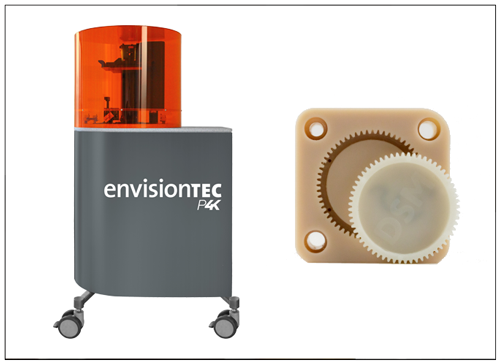
To bring customers a workable and demonstrated material+printer solution, EnvisionTEC and Covestro optimized print parameters and verified Covestro’s new DLP resin e-PerFORM on EnvisionTEC’s Perfactory P4K series printer. EnvisionTEC further tested e-PerFORM resin with key molding institutes to validate the material’s performance. Completed mold trials demonstrate that e-PerFORM resin, with high stiffness and high temperature performance, behaves similarly to stereolithography resin Somos PerFORM for injection molding tooling. 


Tests confirm suitability for rapid mold making 

Tests done by Polyvia, the French Federation of Plastics and Composites, confirm the suitability for rapid tooling. Guy Chrétien, Process project manager at Polyvia confirmed: “We tested the new e-PerFORM resin printed on the EnvisionTEC P4K printer and demonstrated that we could achieve very good results in part fidelity and in the number of shots molded in both polypropylene and glass-reinforced nylon. With the cost effectiveness and print speed of the P4k platform and with the properties of the e-PerFORM resin, this creates additional opportunities for rapid tooling.” Learn more about their testing on Polyvia’s website. 

The combined solution of Covestro DLP resin e-PerFORM on EnvisionTEC’s Perfactory P4K series DLP 3D printing will be presented during RAPID+TCT in Chicago from 13-15 September. 

Al Siblani, EnvisionTEC CEO commented: “The combination of our P4K printer and Covestro e-PerFORM optimized for our printers enables fast, cost-effective production of injection molding tooling. Our collaboration has resulted in a new and much-needed solution.” 

Hugo da Silva, Head of Additive Manufacturing at Covestro commented: “By working closely with our partner EnvisionTEC, we developed a material that meets critical needs voiced in the market: improved dimensional stability and minimal warpage for optimal functionality. The validation and proven solution with their P4K printers will help accelerate the adoption of additive manufacturing of injection mold tooling.”  

To learn more about this solution, visit Covestro (booth E7212) and EnvisionTEC (booth E7501) at RAPID+TCT, September 13-15, 2021. 

About Covestro: 

With 2020 sales of EUR 10.7 billion, Covestro is among the world’s leading polymer companies. Business activities are focused on the manufacture of high-tech polymer materials and the development of innovative, sustainable solutions for products used in many areas of daily life. In doing so, Covestro is fully committed to the circular economy. The main industries served are the automotive and transportation industries, construction, furniture and wood processing, as well as electrical, electronics, and household appliances industries. Other sectors include sports and leisure, cosmetics, health and the chemical industry itself. At the end of 2020, Covestro has 33 production sites worldwide and employs approximately 16,500 people (calculated as full-time equivalents).  

To learn more about the legacy-DSM additive manufacturing business, visit www.dsm.com/additive-manufacturing; for Covestro additive manufacturing please go to addigy.covestro.com. 


About EnvisionTEC: 

EnvisionTEC, a wholly owned subsidiary of Desktop Metal (NYSE: DM), is a leading global provider of professional-grade 3D printing solutions. Founded in 2002 with its pioneering commercial DLP printing technology, EnvisionTEC now sells more than 40 printer configurations based on six distinct technologies that build objects from digital design files. The company’s premium 3D printers serve a variety of medical, professional and industrial markets, and are valued for precision, surface quality, functionality and speed. For more information, please visit envisiontec.com/

Learn more about e-PerFORMTM on EnvisionTEC materials page  

Read More

European demand for Desktop Metal binder jetting gains momentum

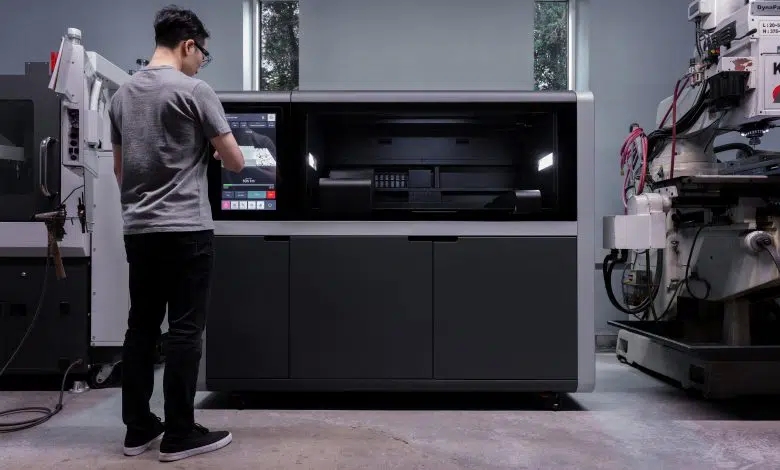
As Desktop Metal continues to advance its Additive Manufacturing 2.0 vision to reshape manufacturing, the company is seeing growing European demand for metal binder jetting, including for its recently released Shop System, a metal binder jetting system designed for machine shops.

Since volume shipments of the Shop System began in the fourth quarter of 2020, the system has reportedly experienced strong adoption among businesses looking to leverage high-quality binder jetting technology to print end-use metal parts in volumes and at costs unattainable through conventional manufacturing and some other metal additive manufacturing processes. In particular, the Shop System is gaining momentum with European customers, with robust demand from manufacturers across countries such as France, Finland, Germany, Greece, Italy, Portugal, Spain, the Netherlands, and the United Kingdom.

“We are now at an inflection point where mid-and high-volume production of end-use metal parts through AM is one of the most transformational opportunities for manufacturers,” said Pierre-Victor Sabatier, VP of Sales – EMEA at Desktop Metal. “With this backdrop, it’s no surprise that there is accelerating interest in binder jetting here in Europe. We are seeing growing adoption of the Shop System as plant operators, engineers, and production managers realize this solution effectively complements their conventional manufacturing operations with reliable, accessible, and flexible batch production of complex and detailed parts at low costs. With the industry shifting to adapt to supply chain challenges and renewed requests for local manufacturing, Desktop Metal is well-positioned to answer the impressive demand we are seeing for production metal AM technologies in Europe and beyond.”

As an integral part of the Additive Manufacturing 2.0 vision, the Shop System is designed to bring metal AM to machines and job shops with an affordable, turnkey solution at speeds that are up to 10 times those of powder bed fusion AM technologies. With the Shop System, users can print end-use metal parts for use in a variety of industries spanning automotive, oil & gas, industrial machinery, and consumer products.

Mid-volume manufacturing


Cosmind, based in Italy, specializes in the processing of precision sheet metal and mechanical carpentry in the naval, railway, aeronautical, and electronic industries. “For Cosmind, continuous and constant growth, the improvement of production processes, quality, competitiveness, and technological innovation are the fundamental points of the company vision,” said Marco Donisi, COO and Plant Manager, Cosmind s.r.l. “Particular emphasis has been placed on technological innovation with the implementation of new technologies in the additive manufacturing sector. The choice of Desktop Metal technology is the right combination of market diversification and technological innovation. We are convinced that the Desktop Metal Shop System technology will significantly contribute to a turning point in the mechanical sector. With this in mind, we have invested in the creation of a technological hub offering ourselves as a 3D printing service with different technologies and materials available to our customers.”

EdilCAM Sistemi (ECS), based in Italy, specializes in seismic retrofitting of buildings and civil structures.“With Desktop Metal’s Shop System, ECS has found a unique and powerful production method that has widened the design boundaries for our company’s patented system, Active Tensioner Multi-Material,” said Alessandro Vari, CEO, EdilCAM Sistemi. “Offering extraordinary performance compared to already existing technologies, ECS can also introduce binder jetting to new areas like bridges and viaducts, but also in monuments and historic buildings. Thanks to Desktop Metal’s binder jetting solutions and ECS’s twenty-year history of seismic strengthening, our company can be the first to introduce metal binder jetting in seismic retrofitting.”

Officine Piki, based in Italy, specializes in stainless steel processing. “The Desktop Metal Shop System presents an important opportunity for the future of additive manufacturing, especially with prototyping, low-cost production, and the ability to make metal parts which cannot be realized with traditional manufacturing methods due to geometries and internal cavities,” said Davide Vitali, General Manager, Officine Piki. “We also believe in the sustainability of [the system’s] 3D printing process thanks to less use of raw materials resulting in a reduction of waste and recycling of materials, reduction of energy used for production, lower use of water than any other production system, no use of chemical emulsions that must be disposed of, and the opportunity for printing with sustainable materials, such as recycled wood dust.”

Poral, based in France, is a leading powder metallurgy supplier, specializing in technical components across automotive, aerospace, chemical processing, and more. “We started to investigate metal additive manufacturing some time ago, but we were waiting for the right solution for our company and customers. We needed a solution that would offer all of the benefits of 3D printing, with greater productivity and reduced costs,” said Denis Pugnet, CEO, Poral. “The Shop System allows us to provide complementary solutions to our customers, enabling them to innovate and save both time and money. It’s also a great business development tool for us, attracting new opportunities and positioning us as a leading player in the local manufacturing and Industry 4.0 fields. We already see some big projects coming to us and we anticipate huge growth in the demand for metal binder jetting parts in the coming months.”

VTT Technical Research Centre of Finland (VTT), based in Finland, is one of Europe’s leading research institutions, helping to advance the utilization and commercialization of research and technology around the world. “The development of metal binder jetting expands the applications of additive manufacturing to an even wider range of new applications that have not previously been commercially meaningful,” said Pasi Puukko, Head of VTT’s research team. “In particular, [Desktop Metal’s Shop System] binder jetting technology is better suited for applications where larger series are needed. With this technology, the range of materials is also expanding to new areas.”


Affordable, batch production

Featuring a single pass print engine, the Shop System offers a turnkey solution for producing complex, end-use metal parts faster than conventional manufacturing and comparably priced AM technologies. The Shop System includes all the equipment machine shops need to begin introducing binder jetting—from printing through sintering—and is designed to scale throughput with a range of build volume configurations. In addition, Desktop Metal offers software for build preparation and sintering simulation, in combination with metal powders and process parameters optimized to increase part quality and repeatability, making it easier for businesses to get up and running with binder jetting.

The Shop System was developed to be easy to use and operate in Additive Manufacturing 2.0 scenarios. Designed with the modern machine shop in mind, the machine produces parts leveraging an easy-to-use software interface. It features engineered powders and default processing parameters optimized to enhance quality and ensure repeatability without extensive third-party materials qualification or process development. The use of software-generated hand-removable sintering setters eliminates the need for costly and labor-intensive post-processing steps.

Featuring variable build sizes up to 16L and a high-speed, single-pass print carriage, the Shop System, like most metal binder jetting systems, has been developed to produce end-use metal parts faster than most metal PBF systems, amplifying existing output with up to hundreds of complex metal parts printed per day, with mechanical properties exceeding industry standards. With speeds up to 800 cc/hour, the Shop System reportedly enables batches of tens or hundreds of complex printed parts in as little as five hours.

Desktop Metal promises that Additive-Manufacturing-2.0-ready businesses will be able to use it to print dense, complex metal parts with fine feature detail and surface finishes as low as four-micron roughness average (Ra) out of the furnace. Leveraging an advanced single-pass printhead, 1600 native DPI, the Shop System promises up to 400 percent higher resolution than legacy binder jetting systems. Reliable print quality is enabled by the 5x nozzle redundancy on the printhead — 25 percent higher redundancy than comparable binder jetting systems.

Please do visit www.3dprintingmedia.network to read the original article, by Andrea Gambini posted on October 8, 2021.

Read More